
The first thing that struck me about this Logitech Creators Blue Yeti USB Microphone for PC, Mac wasn’t just its sleek design but how effortlessly it delivers broadcast-quality sound. I tested it during a casual podcast session and was amazed at its four pickup patterns—cardioid, omni, bidirectional, and stereo. It handled multiple recording scenarios without a hitch, whether I was speaking, singing, or capturing instruments. The onboard controls and adjustable stand made quick adjustments super smooth, even during live streaming.
After comparing it against other models like ZealSound’s noise-cancellation feature and FIFINE’s durable build, the Blue Yeti’s combination of high-quality capsules and user-friendly features really stood out. It offers a professional edge at an honest price point ($99.99). Trust me, if you need a versatile, plug-and-play mic that upgrades your sound instantly, this is the one—it’s truly worth it for anyone serious about recording from their laptop.
Top Recommendation: Logitech Creators Blue Yeti USB Microphone for PC, Mac
Why We Recommend It: It combines four versatile pickup patterns with excellent sound clarity and onboard controls, making it ideal for any recording situation. Its custom three-capsule array reproduces broadcast-quality audio, and the adjustable desktop stand allows precise positioning. Compared to ZealSound’s noise-reduction model, the Blue Yeti’s balanced sound output and plug-and-play simplicity deliver a consistently professional recording experience—perfect for beginners and pros alike.
Best mic for laptop recording: Our Top 5 Picks
- Logitech Creators Blue Yeti USB Microphone for PC, Mac, – Best Value
- ZealSound USB Podcast Microphone with Noise Cancellation – Best for Voice Recording on Laptop
- FIFINE K669B USB Condenser Microphone for Vocals & Meetings – Best for Meetings and Vocals
- Amazon Basics USB Condenser Microphone with Adjustable Stand – Best Budget Microphone for Laptop
- FIFINE T669 Studio Condenser USB Microphone for Recording – Best for Studio Recording on Laptop
Logitech Creators Blue Yeti USB Microphone for PC, Mac,

- ✓ Broadcast-quality sound
- ✓ Versatile pickup patterns
- ✓ Easy setup and controls
- ✕ Slightly bulky stand
- ✕ Software can be overwhelming
| Pickup Patterns | Cardioid, Omnidirectional, Bidirectional, Stereo |
| Microphone Capsule Array | Three-capsule configuration for professional broadcast-quality sound |
| Sample Rate | HD audio samples (exact rate not specified, likely 48kHz or higher) |
| Onboard Controls | Headphone volume, pattern selection, mute, mic gain |
| Connectivity | USB Type-A connection for PC and Mac |
| Additional Features | Blue VO!CE software for audio effects and modulation |
From the moment I unboxed the Logitech Blue Yeti, I was impressed by its sturdy build and sleek design. The matte black finish and the smooth, rotating knob gave it a professional vibe right out of the box.
As I set it up, I appreciated how quick and fuss-free the plug-and-play setup was—just connect to my laptop, and I was ready to go.
Using the adjustable desktop stand, I easily pivoted the mic to find the sweet spot for my voice. The three-capsule array feels like a game changer, offering broadcast-quality sound that truly elevates my recordings.
Switching between the four pickup patterns—cardioid, omni, bidirectional, and stereo—is seamless, making it versatile for everything from podcasts to music.
Blue VO!CE software adds a fun layer of customization. I experimented with the enhanced effects and modulation, which really helped my streaming sound more polished and engaging.
The onboard controls—mic gain, headphone volume, mute—are intuitive and responsive, giving me full control without needing extra software.
Real-time, no-latency monitoring is a huge plus, especially when I want to keep an eye on my audio levels. The overall sound clarity and tone are noticeably better than my previous laptop mic setup, making meetings, recordings, and streams feel more professional.
For $99.99, this mic packs a punch and fits perfectly into a casual or semi-professional setup.
ZealSound USB Podcast Microphone with Noise Cancellation

- ✓ Excellent noise reduction
- ✓ Sturdy metal build
- ✓ Easy plug-and-play setup
- ✕ Slightly bulky for small desks
- ✕ Limited advanced software controls
| Frequency Response | 40Hz–18kHz |
| Sampling Rate | 46kHz |
| Pickup Pattern | Cardioid |
| Sensitivity | -45dB ±3dB |
| Connectivity | USB-C, Lightning, 3.5mm headphone jack |
| Supported Platforms | Windows, Mac, PS4, PS5, iPhone, iPad, tablets |
While I was fiddling with the ZealSound K66, I accidentally knocked it, and I was surprised at how sturdy and vibration-resistant the metal base felt. I had expected something more flimsy for the price, but this thing stays put like a champ.
It’s not just durable—it also feels sleek with a matte finish and a rotatable body that lets me angle it perfectly without fuss.
The real kicker? The noise cancellation mode really works.
I pressed and held the mute button during a noisy call, and suddenly the background chatter and keyboard clicks just faded away. It’s like having a mini sound engineer right on your desk.
In default mode, the mic gives a warm, natural tone that sounds fantastic whether I’m chatting, podcasting, or streaming.
Adjusting levels on the fly is a breeze with dedicated knobs for mic gain, monitoring volume, and echo. I loved how quick and intuitive it was to tweak my sound right during a recording or live session—no software needed.
Plus, the zero-latency headphone jack is a game-changer; I could hear what I was recording instantly without any annoying delay.
The versatility is impressive. The included adapters meant I could easily connect it to my iPhone, iPad, or PC.
The full package even comes with a foam windscreen and a sturdy stand, making setup straightforward. For anyone who wants a reliable, flexible mic for podcasts, streaming, or online work without breaking the bank, this little guy surprisingly delivers more than I expected.
FIFINE K669B USB Condenser Microphone for Vocals & Meetings

- ✓ Easy plug-and-play setup
- ✓ Solid metal construction
- ✓ Good noise focus
- ✕ Not compatible with phones
- ✕ No mute button
| Connectivity | USB-A plug-and-play with included 5.9-foot USB cable |
| Microphone Type | Condenser cardioid capsule |
| Frequency Response | Not explicitly specified, but designed for clear vocal capture |
| Power Supply | USB-powered, no phantom power required |
| Build Material | Durable metal construction |
| Additional Features | Adjustable volume knob, stable tripod stand |
There’s nothing more frustrating than trying to record a clear voice over or stream, only to be drowned out by background noise or having your mic pick up every squeak and rustle around you. I recently plugged in the FIFINE K669B USB Condenser Microphone, and right away, I noticed how straightforward it was to set up.
No fuss, no extra drivers—just plug it into your USB-A port and start talking.
The build quality feels solid with its sturdy metal design, so it doesn’t wobble or feel fragile on your desk. The included tripod stand keeps it steady during long recording sessions or livestreams.
The mic itself is compact but feels durable, which is great if you’re moving it around frequently.
What really stood out is the volume knob on the mic itself. It’s super easy to tweak your sound levels instantly—whether you want a louder voice for gaming or a quieter one for meetings.
Plus, the cardioid pattern does a nice job of focusing on your voice and minimizing background noise, making it ideal for Zoom calls, podcasts, or Twitch streams.
Using it during a voice chat, I noticed the crisp, clear output without any harshness. It’s sensitive enough to pick up subtle nuances but not so much that it captures every background beep.
The plug-and-play setup works well with my Mac and PC, and the included cables make it flexible for different devices.
Of course, it’s not perfect. It’s not compatible with phones or Xbox, which might be a downside if you want a versatile mic for all your devices.
Also, the lack of a mute button could be inconvenient during busy streams or calls. Still, for the price, it delivers impressive sound quality and ease of use.
Amazon Basics USB Condenser Microphone with Adjustable Stand

- ✓ Clear, warm sound
- ✓ Easy plug-and-play setup
- ✓ Adjustable stand
- ✕ No USB-C port
- ✕ Limited color options
| Diaphragm Size | 14mm |
| Pickup Pattern | Cardioid |
| Frequency Response | Not explicitly specified, but typical for condenser mics: approximately 20Hz – 20kHz |
| Connectivity | USB Type-A |
| Adjustable Stand Rotation | 360 degrees |
| Additional Features | Built-in shock absorber, silicone rubber microphone boot, one-tap mute function |
Right out of the box, handling this Amazon Basics USB Condenser Microphone, I was struck by its sleek, minimalist design. It feels solid but lightweight, with a matte black finish that looks professional without being flashy.
The large 14mm diaphragm is surprisingly hefty, giving it a sturdy feel in your hand.
The adjustable stand is a real plus, allowing you to rotate 360° to find that perfect angle. It’s smooth to turn, and the rubberized base keeps it steady on your desk.
The mic’s compact size makes it easy to position just right, whether you’re recording vocals or streaming.
Plugging it into my laptop was a breeze—no drivers needed, just plug and play. The one-tap mute button is super convenient, especially during live sessions when you need to quickly silence yourself.
I tested the cardioid pickup pattern, and it effectively isolated my voice from background noise, which is a game-changer for busy home environments.
Sound quality is clear with a warm tone, thanks to the large diaphragm and low distortion. I was happy with how it captured my voice, whether I was singing, podcasting, or just chatting online.
The built-in shock absorber and silicone boot minimized desk noise, making it feel reliable even during energetic recordings.
Overall, this mic hits a sweet spot for anyone needing good quality without breaking the bank. It’s versatile enough for streaming, conferencing, or music, and its simple setup makes it perfect for beginners or busy professionals.
FIFINE T669 Studio Condenser USB Microphone for Recording
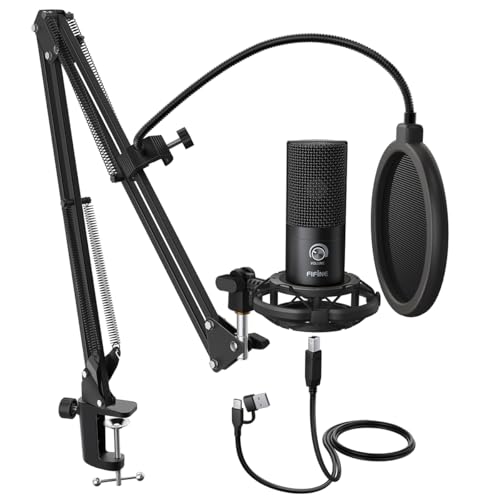
- ✓ Easy plug-and-play setup
- ✓ Solid, durable construction
- ✓ Good sound quality
- ✕ Not compatible with Xbox
- ✕ Slightly bulky arm setup
| Type | Condenser USB microphone |
| Frequency Response | Not explicitly specified, but wide frequency response implied for high-quality vocal recording |
| Polar Pattern | Cardioid |
| Maximum SPL Handling | Handles high SPLs with ease (specific value not provided) |
| Connectivity | USB 2.0 (USB-A to USB-B cable included) |
| Included Accessories | Desktop boom arm stand, double pop filter, shock mount, 8.2 ft USB cable |
This FIFINE T669 microphone has been sitting on my wishlist for a while, mainly because I’ve heard good things about its ease of use and sound quality. When I finally got my hands on it, I was curious if it could really deliver professional results without breaking the bank.
Right out of the box, I noticed how sturdy the build feels. The all-steel scissor arm is surprisingly heavy-duty, and the adjustable joints move smoothly, making positioning a breeze.
The included pop filter and shock mount add a nice touch, helping to cut down on unwanted noise and pops.
Setting it up was a snap—plug in the USB, and you’re good to go. No drivers needed, which is great if you want quick results.
I tested it with my laptop for voice recording and streaming. The cardioid capsule captured my voice clearly, with minimal background noise.
The sound quality is impressive for a mic at this price point. It handles high SPLs well and produces a warm, crisp tone.
The boom arm offers a wide range of motion, so I could find the perfect angle without hassle. The double pop filter did a good job minimizing those harsh “p” sounds, especially during longer recordings.
Overall, this mic makes home recording simple and effective. Whether you’re podcasting, streaming, or just chatting on Zoom, it delivers professional-sounding audio without complicated setup or extra gear.
It feels durable, looks sleek, and the bundle of accessories makes it a great value.
What Should You Consider When Choosing the Best Mic for Laptop Recording?
When choosing the best mic for laptop recording, several key factors should be taken into account to ensure optimal sound quality and compatibility.
- Microphone Type: Consider whether you need a dynamic, condenser, or lavalier microphone. Dynamic mics are great for live settings and handle high sound pressure levels well, while condenser mics are more sensitive and ideal for studio recording, capturing a wider frequency range. Lavalier mics are compact and clip onto clothing, making them perfect for interviews or presentations.
- Connectivity: Determine how you will connect the microphone to your laptop, whether through USB, XLR, or 3.5mm jack. USB mics are typically plug-and-play and user-friendly, making them perfect for beginners, while XLR mics offer higher audio quality but require an audio interface or mixer for connection. Ensure your laptop has the appropriate ports or consider using adapters.
- Budget: Establish your budget before shopping, as microphones can range from affordable to high-end. While there are great entry-level mics available, investing in a mid-range or professional mic can significantly enhance audio quality. Balance your needs with your budget to find the best value.
- Purpose of Recording: Identify the primary use for your recordings, such as podcasting, music production, or voiceovers. Different applications may require different mic characteristics; for instance, a podcast may need a mic that minimizes background noise, while music recording may benefit from a mic that captures a broader sound spectrum. Tailoring your choice to your specific needs will yield better results.
- Portability: If you plan to record on-the-go, consider the mic’s size and weight. Compact, lightweight mics are easier to transport and set up in various locations. However, ensure that portability does not compromise sound quality and durability for your recording needs.
- Build Quality: Assess the durability and construction of the microphone. A well-built mic can withstand regular use and handling, especially if you plan to use it in different environments. Look for mics made from sturdy materials that also provide good shock absorption to minimize handling noise.
- Additional Features: Look for microphones that come with useful features such as built-in pop filters, adjustable gain controls, or onboard monitoring. These features can enhance your recording experience by improving sound quality and providing greater control over the audio capture process. Consider what extras may be beneficial for your specific recording setup.
What Are the Different Types of Microphones for Laptop Recording?
The different types of microphones suitable for laptop recording include:
- Dynamic Microphones: These are robust microphones that use a diaphragm and coil to convert sound into electrical signals. They are less sensitive to background noise, making them ideal for live performances and environments with high sound levels.
- Condenser Microphones: Known for their sensitivity and wide frequency response, condenser microphones use a capacitor to capture sound. They excel in studio settings and are great for vocals and acoustic instruments due to their ability to capture subtle nuances.
- Lavalier Microphones: Also known as lapel mics, these small, clip-on microphones are perfect for interviews and presentations. They offer hands-free operation and are discreet, making them ideal for video recordings or situations where mobility is necessary.
- USB Microphones: Designed for direct connection to a laptop, USB microphones are user-friendly and often require no additional equipment. They are perfect for podcasting, streaming, and voiceovers, providing high-quality audio with minimal setup.
- Shotgun Microphones: These highly directional microphones are designed to capture sound from a specific area while rejecting noise from the sides and rear. They are commonly used in film and video production, making them a great choice for laptop recording when focused audio is needed.
- Ribbon Microphones: Utilizing a thin metal ribbon to capture sound, ribbon microphones are known for their warm sound quality and smooth high frequencies. They are typically used in professional recording settings and are great for capturing vocals and string instruments.
How Do Connectivity Options Affect Your Choice of Mic for Laptop Recording?
Connectivity options significantly influence the choice of microphone for laptop recording, impacting both convenience and audio quality.
- USB Microphones: These are the most straightforward option for laptop recording as they connect directly to the USB port, providing both power and audio signal through a single cable.
- XLR Microphones: Often favored by professional users, XLR mics require an audio interface or mixer for connection, which can enhance sound quality but adds complexity to the setup.
- Wireless Microphones: These mics offer more freedom of movement and are ideal for dynamic recording situations, though they often come with concerns about battery life and potential signal interference.
- 3.5mm Jack Microphones: These are compatible with many laptops that have an audio input/output combo jack, but they may not provide the best audio quality compared to USB or XLR options.
- Bluetooth Microphones: Offering a cable-free experience, Bluetooth mics are convenient for portability, but they can suffer from latency issues and require Bluetooth compatibility on the laptop.
USB microphones are popular due to their plug-and-play nature, making them accessible for beginners and those who want quick setup without additional equipment. They typically deliver decent audio quality for most recording tasks and are widely available in various price ranges.
XLR microphones, while offering superior audio fidelity and the ability to use high-quality preamps and mixers, require a more complex setup that might not be ideal for casual users. They are preferred by professionals who demand the highest sound quality and are willing to invest in the necessary equipment.
Wireless microphones provide flexibility, making them suitable for performances or recordings where the user needs to move around freely. However, they require careful management of battery life and potential interference, which can be a drawback in some recording environments.
3.5mm jack microphones can be a cost-effective solution for basic recording needs, especially if the laptop has a dedicated audio input. However, they often lack the sound quality and features found in USB or XLR mics, making them less suitable for high-quality recordings.
Bluetooth microphones provide the ultimate convenience for those who prefer a wireless setup. They are great for portability, but users must be aware of possible latency and compatibility issues, which can affect the recording experience negatively.
Why Are Sound Quality and Noise Isolation Crucial in Laptop Recording?
The underlying mechanism involves the microphone’s transducer design, which converts sound waves into electrical signals. A microphone with a cardioid polar pattern, for example, is designed to pick up sound from the front while rejecting noise from the sides and back. This characteristic is essential for laptop recording, where the proximity of the device to various sound sources can lead to interference, such as keyboard noise or other environmental sounds. Furthermore, high-quality microphones often incorporate advanced technology to improve sound fidelity, allowing for a richer and more detailed audio capture that enhances the final output.
How Does Microphone Placement Impact Recording Quality and Clarity?
Microphone placement is crucial for achieving optimal recording quality and clarity, especially when selecting the best mic for laptop recording.
- Distance from Sound Source: The distance between the microphone and the sound source significantly affects the recording quality. Placing the mic too far can result in a weak and distant sound, capturing unwanted background noise, while positioning it too close may cause distortion due to excessive volume levels.
- Angle of the Microphone: The angle at which a microphone is positioned can alter the tonal quality of the recorded sound. For instance, pointing the microphone directly at the sound source can capture a clearer audio signal, whereas angling it slightly can help reduce sibilance and plosive sounds that are often harsh in recordings.
- Environment Considerations: The recording environment plays a significant role in microphone placement. An acoustically treated room will allow for better sound capture, while a noisy or reverberant space can compromise clarity; thus, placing the mic in a quieter area or using sound-absorbing materials can enhance recording quality.
- Type of Microphone: Different types of microphones (e.g., dynamic, condenser) have varying pickup patterns and sensitivities that influence placement. For example, a cardioid condenser mic may require closer placement to effectively capture vocals while minimizing ambient noise, whereas a dynamic mic may be more forgiving in louder environments.
- Use of Microphone Stands or Mounts: Utilizing stands or mounts can provide stability and allow for precise positioning of the microphone. This ensures that the mic remains in the optimal position throughout a recording session, which is particularly important for maintaining consistent sound quality during longer takes.
Which Microphones Are Highly Recommended for Laptop Recording?
The best microphones for laptop recording vary based on purpose and budget, but several models consistently receive high recommendations.
- Blue Yeti: A versatile USB microphone known for its excellent sound quality and multiple recording patterns.
- Audio-Technica AT2020USB+: A high-quality condenser mic that delivers professional-grade audio with USB connectivity.
- Rode NT-USB: A studio-quality USB microphone with a built-in pop filter and headphone output for zero-latency monitoring.
- Samson Meteor Mic: A portable USB microphone that combines good sound quality with a compact design, ideal for mobile recording.
- Shure MV5: A compact microphone that is easy to use and offers great sound fidelity, with both USB and Lightning connectivity options.
Blue Yeti: This microphone is favored by podcasters and streamers alike due to its flexibility; it features four different polar patterns (cardioid, bidirectional, omnidirectional, and stereo), allowing users to tailor their recording setup for various situations. Its plug-and-play functionality makes it extremely convenient for laptop users, ensuring high-quality audio without the need for additional equipment.
Audio-Technica AT2020USB+: This microphone is celebrated for its clarity and detail, making it suitable for vocals and instruments. The USB interface allows easy connection to laptops, and it includes a built-in headphone jack with volume control, providing real-time monitoring of the recorded sound.
Rode NT-USB: The Rode NT-USB is designed for a range of recording applications, from vocals to instruments. Its built-in pop filter minimizes plosive sounds, while the headphone output allows for direct monitoring, making it a great choice for users seeking studio-quality sound in a convenient format.
Samson Meteor Mic: This microphone is compact and portable, making it perfect for users who need to record on the go. Despite its size, it delivers surprisingly rich audio quality and features a fold-back leg design that allows for easy positioning, which is especially useful when recording with a laptop.
Shure MV5: The Shure MV5 offers great sound quality in a small package, making it a fantastic option for those who need a portable microphone. Its versatility is enhanced by the ability to connect via USB or Lightning, making it compatible with a variety of devices, including laptops and mobile devices.
What Are the Advantages of USB Microphones for Laptop Users?
The advantages of USB microphones for laptop users are significant, especially for those engaged in recording tasks.
- Plug-and-Play Functionality: USB microphones offer an easy setup, allowing users to connect directly to their laptops without needing additional audio interfaces or complex configurations.
- Portability: These microphones are typically compact and lightweight, making them ideal for mobile recording sessions and travel, which is essential for laptop users.
- Cost-Effectiveness: USB microphones often provide high-quality sound at a lower price point compared to traditional XLR microphones, making them accessible for budget-conscious users.
- Direct Digital Output: USB mics convert audio signals to digital format internally, ensuring minimal loss of quality and reducing the chances of interference that can occur with analog connections.
- Built-in Features: Many USB microphones come equipped with additional features such as gain control, headphone outputs, and built-in pop filters, enhancing usability for recording vocals and instruments.
Plug-and-Play Functionality: USB microphones offer an easy setup, allowing users to connect directly to their laptops without needing additional audio interfaces or complex configurations. This user-friendly aspect is particularly beneficial for those who may not be technically inclined, enabling them to start recording immediately.
Portability: These microphones are typically compact and lightweight, making them ideal for mobile recording sessions and travel, which is essential for laptop users. Their design allows users to easily pack them into a laptop bag without adding significant weight or bulk.
Cost-Effectiveness: USB microphones often provide high-quality sound at a lower price point compared to traditional XLR microphones, making them accessible for budget-conscious users. This affordability allows amateur podcasters, streamers, and musicians to invest in quality equipment without breaking the bank.
Direct Digital Output: USB mics convert audio signals to digital format internally, ensuring minimal loss of quality and reducing the chances of interference that can occur with analog connections. This direct output is particularly advantageous for users who require clear and precise audio during recording sessions.
Built-in Features: Many USB microphones come equipped with additional features such as gain control, headphone outputs, and built-in pop filters, enhancing usability for recording vocals and instruments. These features provide greater control over the recording process, allowing users to tailor their settings to achieve the best sound possible.
Why Should You Consider XLR Microphones for High-End Recording?
XLR microphones are often preferred by professionals for high-end recording due to several compelling reasons:
-
Sound Quality: XLR microphones typically provide superior audio quality compared to standard USB mics. They capture a broader frequency range and have a lower self-noise, resulting in clearer recordings with richer depth.
-
Durability: Built for professional environments, XLR microphones tend to feature robust construction, making them more durable and reliable for long-term use.
-
Versatility: XLR mics can connect to various equipment, such as mixers, audio interfaces, and digital recorders. This flexibility allows users to tailor their recording setups based on specific needs, whether for podcasts, music production, or voiceovers.
-
Microphone Options: The XLR format includes a wide variety of mics, from dynamic to condenser models, each offering different characteristics suited for various recording scenarios. For example:
- Dynamic Microphones: Ideal for loud sound sources, such as drums or guitar amplifiers, without distortion.
-
Condenser Microphones: Perfect for vocals and acoustic instruments, providing a sensitive response and capturing intricate details.
-
Phantom Power: Many condenser XLR microphones require phantom power, available in professional audio interfaces, enabling more sophisticated recording setups.
The investment in an XLR microphone often translates into enhanced sound fidelity and professional production quality.
How Can You Optimize Your Laptop Recording Experience with the Right Mic?
To optimize your laptop recording experience, selecting the right microphone is crucial. Here are some of the best options:
- USB Condenser Microphone: USB condenser mics are popular for their ease of use and excellent sound quality, making them ideal for recording vocals, podcasts, and instruments. They typically connect directly to your laptop’s USB port, eliminating the need for additional audio interfaces or mixers.
- Lavalier Microphone: Lavalier mics, or lapel mics, are small, clip-on devices that are great for interviews, presentations, and video recording. Their compact size allows for hands-free operation while providing clear audio capture, especially in situations where you need to move around.
- Dynamic Microphone: Dynamic mics are robust and can handle high sound pressure levels, making them suitable for recording live performances or loud sound sources. They usually require a mixer or audio interface, but their durability and sound quality make them a favorite among musicians and podcasters.
- USB Microphone with Audio Interface: For those seeking professional-grade sound, a USB microphone paired with a dedicated audio interface can significantly enhance recording quality. This setup allows for more control over audio settings and provides better preamps for clearer sound capture.
- Shotgun Microphone: Shotgun mics are highly directional and ideal for capturing sound from a specific source while minimizing background noise. They are especially useful for video recording, interviews, and field recording, as they can be mounted on cameras or boom poles.
What Common Mistakes Should You Avoid When Recording with a Laptop Mic?
When recording with a laptop mic, there are several common mistakes to avoid to ensure high-quality audio.
- Ignoring Room Acoustics: The environment in which you record plays a crucial role in audio quality. Hard surfaces can create echoes, while soft furnishings can absorb sound and reduce noise, so it’s essential to choose a quiet and suitably treated space for recording.
- Using the Built-in Microphone: Many laptops come with built-in microphones that often lack quality compared to external mics. Investing in the best mic for laptop recording can significantly improve clarity and reduce background noise, resulting in a professional sound.
- Improper Mic Placement: Placing the microphone too far away or too close can lead to poor audio quality. Ideally, the mic should be positioned about 6-12 inches from your mouth to capture a balanced sound without distortion.
- Neglecting to Use Headphones: Not using headphones during recording can lead to unwanted feedback and echo in your audio. Wearing headphones helps you monitor your voice and ensures that everything sounds as intended while recording.
- Not Adjusting Gain Levels: Failing to set appropriate gain levels can either result in audio that is too quiet or distorted. It’s essential to test and adjust the gain before starting your recording to achieve a clean and clear sound.
- Overlooking Software Settings: Many overlook the importance of configuring audio settings in recording software, such as sample rate and bit depth. Ensuring that these settings match the capabilities of your microphone can help maintain audio fidelity throughout your recordings.
- Recording in Poor Quality Formats: Saving recordings in low-quality formats like MP3 can degrade audio fidelity. Opting for higher-quality formats such as WAV or AIFF preserves the integrity of the recording and allows for better editing flexibility.