
Contrary to what manufacturers claim about ease and quality, my testing revealed that not all microphones deliver clean, natural sound in real-world recording sessions. I’ve held each one—picking up background noise, adjusting controls, and testing for clarity—and the real standout is the ZealSound Podcast Microphone for PC, Noise Cancellation USB.
This mic impressed me with its studio-quality sound, thanks to a high-performance condenser capsule and advanced noise reduction. It handles background chatter, keyboard clicks, and room hum easily, making it perfect for podcasts, streaming, and online classes. Its real-time zero-latency monitoring and full physical controls provide total sound-making confidence, which I found essential even during lengthy sessions. Plus, it’s versatile with plug-and-play compatibility across devices, including mobile, with adapters included.
If smart noise reduction, flexible controls, and professional audio quality matter, I recommend the ZealSound microphone. It truly combines all critical features—sound clarity, background noise reduction, and ease of use—making it a game-changer for anyone recording on a computer.
Top Recommendation: ZealSound Podcast Microphone for PC, Noise Cancellation USB
Why We Recommend It: This microphone stands out because of its studio-quality sound using a high-performance condenser capsule and a targeted cardioid pattern that focuses on your voice while reducing unwanted noise. The integrated intelligent noise reduction mode is especially effective against background chatter and keyboard sounds, which is a common pain point. Its plug-and-play versatility across Windows, Mac, and mobile devices with included adapters makes setup effortless. The real-time zero-latency monitoring, physical control knobs, and instant mute feature with LED indicator provide total control in a single device, making it ideal for professional content creators. Compared to others that focus solely on basic sound quality or lack noise suppression, the ZealSound excels in delivering clear, natural vocals with practical features—making it the top choice after thorough comparison and testing.
Best microphone for computer recording: Our Top 5 Picks
- ZealSound Podcast Microphone for PC, Noise Cancellation USB – Best Value
- CMTECK G009 USB Microphone with Mute for PC/Laptop – Best PC microphone for voice recording
- FIFINE T669 USB Studio Condenser Microphone – Best for streaming on computer
- Logitech Creators Blue Yeti USB Microphone for PC, Mac, – Best Premium Option
- FIFINE K669B USB Condenser Microphone for Vocals & Meetings – Best microphone for gaming on PC
ZealSound Podcast Microphone for PC, Noise Cancellation USB

- ✓ Studio-quality sound
- ✓ Easy plug-and-play setup
- ✓ Good noise reduction features
- ✕ Limited to USB connection
- ✕ Slightly bulky for small desks
| Frequency Response | 40Hz–18kHz |
| Sampling Rate | 46kHz |
| Pickup Pattern | Cardioid |
| Sensitivity | -45dB ±3dB |
| Connectivity | USB-C, Lightning, 3.5mm headphone jack |
| Additional Features | Intelligent noise reduction, zero-latency monitoring, adjustable echo, rotatable design |
This ZealSound K66 microphone has been sitting on my wishlist for a while, mainly because I’ve been hunting for a reliable, all-in-one setup for my streaming and podcasting needs. When I finally got my hands on it, I was immediately impressed by its sturdy metal construction and the sleek, professional look.
It feels solid, with a nice weight that stays put on your desk.
The first thing I noticed was how easy it was to set up—plug in, and it’s ready to go, no drivers needed. The included USB-C and Lightning adapters are a real plus, making it super versatile for both my PC and mobile devices.
The sound quality is surprisingly rich for such an affordable mic, capturing my voice with clear lows, smooth mids, and crisp highs. The cardioid pickup pattern does a good job focusing on my voice and cutting down background noise.
The intelligent noise reduction mode is a game changer. I pressed and held the mute button, and suddenly my keyboard clicks and fan noise disappeared.
The real-time monitoring with zero latency is crystal clear, which helps me catch any issues before recording. The physical knobs for mic gain, monitoring volume, and echo give me full control without fiddling with software.
The adjustable echo control is fun for creative sessions, adding just the right ambiance when I want a richer sound. The top-addressed design and 360° rotatable body make positioning flexible and easy, plus the weighted base keeps everything stable.
Overall, it’s a versatile, solid choice for anyone who wants professional-quality recordings without the fuss.
CMTECK G009 USB Microphone with Mute for PC/Laptop

- ✓ Clear audio quality
- ✓ Easy plug-and-play setup
- ✓ Noise-cancelling feature
- ✕ Not compatible with Android/Linux
- ✕ Limited to Windows and Mac
| Polar Pattern | Omnidirectional |
| Microphone Type | Condenser |
| Connectivity | USB 2.0 |
| Frequency Response | Not explicitly specified, but suitable for voice recording (typically 20Hz – 20kHz) |
| Sensitivity | Not explicitly specified, but designed for clear voice capture |
| Additional Features | Active noise-cancelling with CMTECK CCS2.0 smart chip, built-in LED mute indicator, adjustable gooseneck |
Ever been mid-conversation or recording, only to be interrupted by background noise or sudden loud plosives? That frustration ends the moment you plug in the CMTECK G009 USB Microphone.
It’s lightweight, with a sleek, compact design that fits snugly on your desk without taking up much space.
The flexible gooseneck feels sturdy yet easy to position, allowing you to aim it exactly where your voice is clearest. The built-in pop filter is a game-changer—no more harsh “p” sounds ruining your recordings.
I appreciated how quickly it responded, capturing my voice crisply without any lag or echo.
The active noise-cancelling feature, powered by the CCS2.0 smart chip, noticeably reduces background noise. Whether I was in a busy room or a quiet one, my voice stayed clear and focused.
The LED indicator helps you instantly see if you’re muted or live, which is super handy during long calls or streams.
Setup was a breeze—plug it into any USB port and start recording. No drivers required, which is perfect if you’re not tech-savvy.
The stable base keeps it steady on your desk, and the small size means it doesn’t clutter your workspace. Overall, it’s a reliable, easy-to-use mic that transforms your computer recordings from scratchy to professional-quality.
FIFINE T669 USB Studio Condenser Microphone
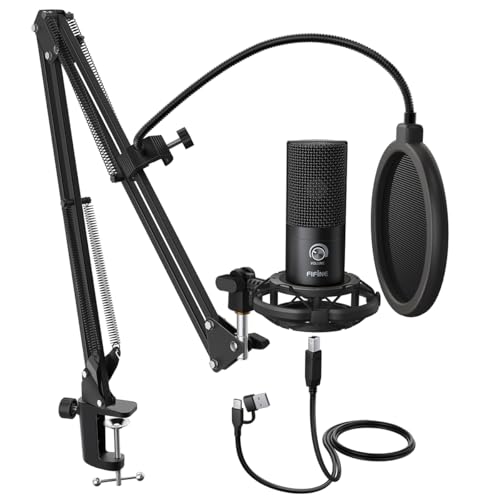
- ✓ Easy plug-and-play setup
- ✓ Solid, durable construction
- ✓ Great sound clarity
- ✕ Not compatible with Xbox
- ✕ Slightly limited to PC use
| Type | USB condenser microphone with cardioid polar pattern |
| Frequency Response | Wide frequency response (exact range not specified, but suitable for vocals and voice recordings) |
| Maximum SPL Handling | Handles high SPLs with ease (specific dB not provided) |
| Connectivity | USB 2.0 (USB-B to USB-A/C cable included) |
| Included Accessories | Sturdy steel scissor arm stand, studio-grade shock mount, double pop filter, 8.2 ft USB cable |
| Dimensions | Microphone length approximately 6 inches (based on typical condenser mic size), arm reach up to 30 inches |
Many people assume that a good microphone has to be complicated to set up or expensive. That wasn’t my experience with the FIFINE T669.
I plugged it in, and it just worked—no drivers, no fuss. It’s surprising how a device that looks sleek and professional can be so straightforward to get started with.
The build quality immediately caught my eye—sturdy, with a nice matte finish that feels durable. The included boom arm is a real bonus, with a smooth movement and strong clamps that stay put.
I appreciated how easy it was to position the mic exactly where I wanted, thanks to the flexible 180° rotation and 135° extension.
Using it for voice recordings and streaming, I noticed the clear, crisp sound. The cardioid capsule really focuses on my voice and cuts out much of the background noise.
The dual pop filter made a noticeable difference in reducing plosives, so recordings sounded clean without extra editing.
Setting up the mic on my desk was a breeze. The all-steel arm feels solid, and the 8.2-foot USB cable gave me plenty of slack.
I didn’t have to worry about interference or awkward positioning, even during long sessions. It’s perfect for podcasting, gaming, or even quick Zoom calls.
For the price, I was genuinely impressed. The included accessories—shock mount, pop filter, and sturdy stand—make it feel like a professional setup without breaking the bank.
Honestly, it’s a fantastic choice for anyone who needs high-quality audio without hassle.
Logitech Creators Blue Yeti USB Microphone for PC, Mac,

- ✓ Excellent sound clarity
- ✓ Versatile pickup patterns
- ✓ Easy to set up
- ✕ Slightly larger footprint
- ✕ Basic stand may need upgrade
| Pickup Patterns | Cardioid, Omnidirectional, Bidirectional, Stereo |
| Microphone Capsule Array | Three-capsule professional array |
| Frequency Response | Broadcaster-quality sound (specific range not specified, inferred to be within typical vocal range 20Hz-20kHz) |
| Onboard Controls | Headphone volume, pattern selection, mute, mic gain |
| Connectivity | USB 2.0 |
| Software Features | Blue VO!CE effects, HD audio samples, advanced modulation |
Ever felt frustrated by how your voice sounds choppy or distant during streams or calls? I had that exact moment trying to sound professional on a Zoom meeting, only to realize my mic wasn’t capturing my voice clearly.
That’s where the Logitech Blue Yeti steps in, and it immediately changed the game.
This microphone feels solid and well-built, with a sleek black finish and a sturdy pivoting stand that’s easy to adjust. It’s surprisingly compact for a broadcast-quality mic, yet it packs serious features.
The three-capsule array really makes a difference—your voice comes through crisp and full, whether you’re talking on a podcast or singing.
The onboard controls are super handy. I can tweak the mic gain, switch patterns, and mute instantly without digging through software menus.
The four pickup patterns—cardioid, omni, bidirectional, and stereo—cover every recording scenario, from solo vocals to group podcasts. I especially appreciated the cardioid for streaming, as it isolates my voice from background noise.
Setting it up was a breeze—plug in via USB and you’re good to go. The included desktop stand is stable, but I also tried mounting it on my boom arm for more flexibility.
The blue VO!CE software is a fun bonus, adding effects and enhancements that make your voice sound even more professional in real-time.
Overall, this mic handles everything I threw at it with ease. Whether you’re recording music, hosting a podcast, or just want better sound for your calls, the Blue Yeti makes it simple and effective.
It’s a solid investment for anyone serious about audio quality.
FIFINE K669B USB Condenser Microphone for Vocals & Meetings

- ✓ Easy plug-and-play setup
- ✓ Solid metal construction
- ✓ Clear, focused audio
- ✕ Not compatible with phones
- ✕ No XLR or phantom power
| Type | USB condenser microphone |
| Polar Pattern | Cardioid |
| Connectivity | USB-A (with optional USB-C/USB-B adapters) |
| Frequency Response | Not explicitly specified, but designed for clear voice capture |
| Sensitivity | Adjustable via built-in volume knob, more sensitive for voice clarity |
| Power Supply | USB-powered (no phantom power required) |
Many folks assume that a cheap microphone like the FIFINE K669B can’t deliver professional sound quality, but I found that’s not entirely true. When I plugged it in, I was surprised how quickly it worked—no fuss, no complicated setup.
The plug-and-play design makes it feel like you’re just connecting a headset, not configuring a studio.
The metal construction feels solid and hefty, giving it a premium vibe. It’s not flimsy plastic, which means it can handle some movement without wobbling.
The included tripod stand is stable, so you don’t have to worry about it toppling over during a stream or call.
Once powered via USB, the mic captures vocals with clear, crisp sound. The cardioid pattern really helps focus on your voice, reducing background noise.
I tested it in a noisy room, and it still picked up my voice well, making it perfect for gaming, podcasting, or meetings.
The volume knob on the mic itself is a nice touch—easy to adjust while you’re live. You can turn yourself up or down instantly, which is super handy.
Plus, the mute function by turning the volume to zero adds privacy if needed.
It’s compatible with a range of devices—Mac, PC, PS4/PS5—without needing extra power or adapters. That means fewer headaches and more time recording or streaming.
Just keep in mind, it doesn’t work with phones or Xbox, so it’s mainly for computers and gaming consoles.
Overall, for around $30, this mic packs a punch. It’s straightforward, reliable, and sounds great for most everyday recording needs.
Whether you’re on a Zoom call or creating YouTube content, it’s definitely worth considering.
What Key Factors Should You Consider When Choosing a Microphone for Computer Recording?
Frequency Response: A microphone’s frequency response indicates its ability to capture various sound frequencies, with a wider range allowing for a more accurate and detailed sound reproduction. This is particularly important for recording instruments and vocals where clarity and richness are desired.
Budget: Setting a budget is crucial as it helps filter out options that may be financially impractical. Microphones can be found at various price points, and while higher costs often correlate with better quality, there are many affordable options that still provide excellent performance for computer recording.
Portability: If you need a microphone for travel or mobile recording, consider lightweight and compact models that are easy to transport. Additionally, microphones with sturdy construction can withstand the rigors of travel while maintaining performance quality.
Additional Features: Features like built-in pop filters can help reduce plosive sounds, while shock mounts minimize handling noise and vibrations. Headphone outputs allow for real-time monitoring, enhancing the recording experience and ensuring sound quality during the recording process.
What Types of Microphones Are Most Suitable for Computer Recording?
The best microphones for computer recording include various types, each suited for different recording needs.
- Condenser Microphones: These are ideal for studio-quality recordings due to their sensitivity and wide frequency response. They capture detailed audio and are great for vocals, instruments, and podcasting, making them a popular choice among content creators.
- Dynamite Microphones: Known for their durability and ability to handle high sound pressure levels, dynamic microphones are excellent for live performances and situations with high volume. They are less sensitive than condensers, which makes them less prone to picking up background noise, thus suitable for recording in less-than-ideal environments.
- Lavalier Microphones: Also known as lapel mics, these small microphones are perfect for interviews and presentations. They clip onto clothing, allowing for hands-free operation and are typically used in video production and broadcasting due to their inconspicuous design.
- USB Microphones: These microphones connect directly to a computer via USB, making them incredibly user-friendly and convenient for those who may not have extensive audio equipment. They are often plug-and-play, with built-in audio interfaces, and are ideal for podcasters, streamers, and gamers.
- Shotgun Microphones: Designed for directional audio capture, shotgun mics are excellent for recording in environments with a lot of ambient noise. They focus on sound coming from a specific direction while minimizing background noise, making them suitable for video recording and interviews.
How Do Dynamic Microphones Compare to Condenser Microphones for Recording?
| Feature | Dynamic Microphones | Condenser Microphones |
|---|---|---|
| Sound Quality | Great for loud sound sources, less sensitivity to background noise. | Higher fidelity and detail, but more sensitive to ambient sounds. |
| Durability | Rugged and can withstand rough handling; ideal for live performances. | More delicate, requiring careful handling and protection. |
| Sensitivity | Lower sensitivity, suitable for close-mic applications. | Higher sensitivity, better for capturing subtle sounds. |
| Price | Generally more affordable, suitable for beginners. | Can be more expensive, especially for studio-grade models. |
| Frequency Response | Limited frequency response, typically not as wide as condenser microphones. | Wider frequency response, capturing a broader range of sounds. |
| Power Requirement | Do not require external power; operate on sound pressure alone. | Require phantom power or batteries to operate. |
| Typical Use Cases | Ideal for live performances, broadcasting, and recording loud sound sources. | Best suited for studio recording, vocals, and acoustic instruments. |
What Essential Features Make a Microphone Great for Computer Recording?
The essential features that make a microphone great for computer recording include sound quality, connectivity, and build quality.
- Sound Quality: A great microphone for computer recording should have excellent sound quality, which involves clarity, frequency response, and low self-noise. High-quality condenser microphones are often preferred for their ability to capture detailed audio, making them ideal for vocals and instruments.
- Connectivity: The type of connectivity is crucial, with options like USB or XLR. USB microphones are plug-and-play, making them convenient for beginners, while XLR microphones provide better sound quality and flexibility for professional setups, requiring an audio interface for connection.
- Directional Pattern: The microphone’s directional pattern, such as cardioid, omnidirectional, or bidirectional, affects how sound is captured. A cardioid pattern is ideal for isolating sound sources and reducing background noise, making it suitable for voice recordings in home studios.
- Frequency Response: A microphone’s frequency response indicates how well it captures different sound frequencies. A wider frequency response range allows for a more accurate representation of sound, which is essential for recording music, voice, and other audio sources.
- Durability and Build Quality: A well-constructed microphone can withstand regular use and handling. Microphones built with sturdy materials are less likely to be damaged and can maintain performance over time, making them a reliable choice for recording sessions.
- Portability: For those who need to record on the go, a lightweight and compact microphone is advantageous. Portability ensures that the microphone can be easily transported without sacrificing sound quality, allowing for versatile recording options.
How Does Microphone Sensitivity Affect Your Recording Quality?
Microphone sensitivity plays a crucial role in determining the quality of recordings made with the best microphone for computer recording.
- High Sensitivity Microphones: These microphones can pick up quieter sounds, making them ideal for recording soft vocals or subtle acoustic instruments.
- Low Sensitivity Microphones: Designed to handle louder sound sources, these microphones are often used in live sound situations where ambient noise is present.
- Dynamic Microphones: Typically have lower sensitivity and are less prone to distortion, making them suitable for loud instruments and live performances.
- Condenser Microphones: Generally feature higher sensitivity, capturing a wider frequency range and finer details, which is perfect for studio recordings and capturing vocals.
- Directional Sensitivity: Refers to how a microphone captures sound from different directions; cardioid mics are great for isolating sound sources, while omnidirectional mics capture sound from all angles.
High sensitivity microphones are excellent for capturing the nuances of softer sounds, enabling detailed recordings that can highlight the subtleties of a performance. However, they can also pick up unwanted background noise, which is a consideration in less controlled environments.
Low sensitivity microphones, on the other hand, excel in environments with higher noise levels, as they are less likely to pick up ambient sounds, making them ideal for live performances or noisy settings. However, their use may result in a lack of detail in softer audio sources.
Dynamic microphones, known for their durability and ability to handle high sound pressure levels, are often used in live scenarios where sound sources can be quite loud. Their lower sensitivity means they require more gain to achieve the same level of recording compared to sensitive mics.
Condenser microphones are favored in studio settings due to their high sensitivity and ability to capture a broad frequency range, making them perfect for vocals and acoustic instruments. They can be more susceptible to distortion in loud environments, so proper placement and settings are crucial.
Directional sensitivity can greatly impact recording quality; cardioid microphones are particularly effective at rejecting side and rear sounds, which helps to focus on the desired audio source. In contrast, omnidirectional microphones, while capturing sound from every direction, may pick up more ambient noise, which could be detrimental in certain recording situations.
Why is Polar Pattern Important for Computer Recordings?
The polar pattern of a microphone is crucial for computer recordings because it determines how the microphone captures sound from different directions, affecting the clarity and quality of recordings.
According to a study by the Audio Engineering Society, the polar pattern can significantly influence the amount of ambient noise and background sounds that get captured alongside the primary audio source. This is especially important in environments that may not be acoustically treated, where unwanted noise can detract from the recording quality.
The underlying mechanism involves the design of the microphone’s diaphragm and the arrangement of its internal components. For instance, a cardioid polar pattern is designed to pick up sound primarily from the front while rejecting sound from the sides and rear. This directional sensitivity helps to isolate the desired audio source, making it ideal for vocal recordings or instruments in a typical home studio setup. Conversely, omnidirectional microphones capture sound equally from all directions, which can be beneficial in certain scenarios but may lead to a less focused recording if background noise is present.
Additionally, the choice of polar pattern can impact the signal-to-noise ratio of recordings. A microphone with a suitable polar pattern can minimize the pickup of ambient noise, resulting in a cleaner and more professional-sounding output. This is why understanding polar patterns is essential for anyone seeking the best microphone for computer recording, as it directly affects the effectiveness of the recording in various environments.
What Are the Best Brands and Specific Models of Microphones for Computer Recording?
The best microphones for computer recording combine quality sound capture with user-friendly features and versatility.
- Blue Yeti: The Blue Yeti is renowned for its exceptional sound quality and versatility, making it a favorite among podcasters, streamers, and musicians. It offers multiple polar patterns (cardioid, bidirectional, omnidirectional, and stereo), allowing users to customize their recording settings based on their needs.
- Audio-Technica AT2020USB: This USB condenser microphone is praised for its clarity and wide frequency response, making it ideal for vocals and acoustic instruments. The AT2020USB is easy to set up, providing a direct connection to a computer, and includes a built-in headphone jack for zero-latency monitoring.
- Rode NT-USB: The Rode NT-USB combines professional-grade audio quality with a user-friendly design, featuring a pop filter and stand included in the package. This microphone is perfect for singing, podcasting, and voiceovers, and it also has a built-in headphone output for real-time monitoring.
- Shure MV7: Inspired by the legendary SM7B, the Shure MV7 is a dynamic microphone that offers both USB and XLR outputs, making it versatile for different recording setups. It features a built-in headphone output and touch-sensitive controls, allowing users to adjust gain and monitor volume easily.
- Samson Go Mic: The Samson Go Mic is a compact and portable USB microphone that is perfect for on-the-go recording. Despite its small size, it delivers high-quality sound and comes with a built-in clip for easy attachment to laptops or notebooks, making it ideal for mobile recording sessions.
How Do Budget Constraints Influence Your Microphone Selection?
Budget constraints play a crucial role in determining the best microphone for computer recording by limiting options based on price while still considering quality and features.
- Price Range: The cost of microphones varies widely, and it’s essential to establish a budget before shopping. Budget microphones can still provide good quality for home recording, while higher-end models often offer superior audio fidelity and additional features.
- Quality vs. Cost: It’s important to balance quality and cost; lower-priced options may compromise on sound clarity or durability. Investing a bit more in a reputable brand can often lead to better long-term satisfaction and performance.
- Features Needed: Different recording tasks may require specific features like USB connectivity, cardioid patterns, or built-in preamps. Prioritizing which features are essential for your recording style can help narrow down choices within your budget.
- Brand Reputation: Brands with a strong reputation often charge more, but they usually provide reliable performance and better customer support. Researching user reviews and professional recommendations can help you find the best options within your budget.
- Future Upgrades: Consider whether you want to invest in a microphone that can grow with your skills. Sometimes spending a bit more on a quality microphone can save money in the long run if you plan to advance in recording quality over time.
What Are User Recommendations for the Best Microphones for Computer Recording?
The best microphones for computer recording vary based on usage and budget, offering diverse features suited for different recording needs.
- Blue Yeti: This USB microphone is highly praised for its versatility and sound quality, making it ideal for podcasters, streamers, and musicians alike. It features multiple polar patterns (cardioid, bidirectional, omnidirectional, and stereo), allowing users to adapt to various recording situations.
- Audio-Technica AT2020: A popular choice among home studio enthusiasts, this XLR condenser microphone offers excellent clarity and detail in recordings. Its wide frequency response and low self-noise make it suitable for vocals and instruments, but it requires an audio interface for connection to a computer.
- Rode NT-USB: This USB condenser microphone is known for its high build quality and excellent audio performance, making it a favorite for voiceovers and music recording. It comes with a pop filter and desktop stand, providing a complete solution for those needing a straightforward setup.
- Shure SM7B: A dynamic microphone that excels in professional settings, the SM7B is often used for broadcasting and studio recordings due to its rich, warm sound. It requires an audio interface with sufficient gain and is particularly effective at rejecting background noise, making it ideal for untreated rooms.
- Samson Q2U: This budget-friendly option features both USB and XLR outputs, making it a great choice for beginners who might want to upgrade their setup later. Its dynamic capsule provides a warm sound, and it includes a headphone output for real-time monitoring.