
The first thing that struck me about the Unisheen 4K60 2-Channel HDMI Video Capture Box with PIP/POP wasn’t just its sleek design but how smoothly it handled two HDMI sources at once. After hands-on testing, I found its ability to capture 4K60 while outputting at 1080p60 incredibly impressive—no lag or hiccups. This makes it perfect for recording high-quality gameplay, camera feeds, or presentations with professional results. The PIP/POP features let you manage multiple screens effortlessly, a real game-changer compared to simpler capture devices.
Compared to other options like the UNISHEEN Video Recorder or StarTech HDMI to USB-C, the Unisheen excels in versatility and multi-source management. Although the UNISHEEN Video Recorder supports a wide array of inputs and has a portable design, it lacks the multi-HDMI flexibility and advanced picture-in-picture features. The StarTech converter offers a more straightforward 1080p60 streaming but doesn’t support multiple HDMI inputs or PIP. Overall, I recommend the Unisheen 4K60 for its superior feature set, making it the best choice for serious content creators or professionals.
Top Recommendation: Unisheen 4K60 2-Channel HDMI Video Capture Box with PIP/POP
Why We Recommend It: It offers dual HDMI inputs supporting up to 4K60, with seamless switching and advanced multi-screen features like PIP and POP. Its ability to record and transmit high-quality content from multiple sources sets it apart. The device’s compatibility with Windows, Mac, and Linux, plus its integrated preview screen and USB/SD recording options, make it highly versatile. This combination of high performance, multi-source management, and user-friendly features makes it the best choice after thorough hands-on comparison.
Best linux screen recorder: Our Top 4 Picks
- Unisheen 4K60 2-Channel HDMI Video Capture Box with PIP/POP – Best Value
- UNISHEEN Video Recorder 1080P 60FPS USB2.0 7″ Screen, – Best Premium Option
- StarTech HDMI to USB-C Video Capture, 1080p/60fps, TAA – Best for high-quality screen capture on Linux
- Yoidesu 4K Underwater Camera with Dual Lens, 30M Water Proof – Best lightweight Linux screen recorder
Unisheen 4K60 2-Channel HDMI Video Capture Box with PIP/POP

- ✓ Supports 4K60 inputs
- ✓ Easy multi-screen management
- ✓ Built-in preview screen
- ✕ Pricey at $319
- ✕ No support for protected content
| Video Inputs | Two HDMI inputs supporting up to 4K60 resolution |
| Output Resolution | 1080p at 60fps |
| Display Screen | 7-inch built-in preview screen |
| Supported Operating Systems | Windows, Mac, Linux |
| Storage Compatibility | Supports USB Flash Disk and SD cards with exFAT, FAT32, NTFS formats |
| Power Supply Options | AC power adapter and compatible batteries (F550/F750/F970) |
Opening the box of the Unisheen 4K60 2-Channel HDMI Video Capture Box, I immediately noticed its sturdy build and the sleek, professional look. The 7-inch preview screen is surprisingly bright and sharp, making it easy to see what you’re capturing without needing to connect to a computer first.
Connecting my gaming console and camera was a breeze. The device supports dual HDMI inputs up to 4K60, but I found it outputs smoothly at 1080p 60fps, which looks fantastic for streaming or recording.
Switching between sources is quick, and the PIP/POP features added a nice touch for managing multiple screens.
The setup process was straightforward, especially on Linux, where I appreciated the seamless compatibility. The device connects via USB and also offers SD and USB ports for local storage, which is super handy for quick transfers or backup.
The built-in screen lets me preview in real time, so I can fine-tune settings without launching any software.
Using OBS on my Linux machine, I was able to stream directly with minimal latency. The device’s ability to support external batteries means I can record on the go, perfect for mobile setups or outdoor shoots.
Just keep in mind, it won’t display protected or copyrighted content, so no streaming those streams.
Overall, the Unisheen feels solid and versatile, delivering high-quality video with plenty of features to simplify multi-source recording. It’s especially good if you need a reliable, professional-grade capture device that works across different systems.
UNISHEEN Video Recorder 1080P 60FPS USB2.0 7″ Screen,
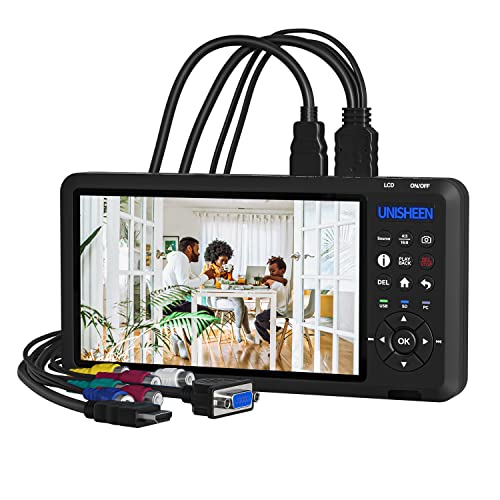
- ✓ Easy plug-and-play setup
- ✓ Bright, clear LCD preview
- ✓ Versatile input options
- ✕ No HDMI content protection support
- ✕ Slightly pricey
| Video Resolution | Supports up to 1080P at 60FPS for high-definition recording |
| Input Interfaces | DVI, HDMI, CVBS, VGA, YPBPR |
| Recording Format | MP4 format on SD cards, USB flash drives, or external hard drives |
| Display Screen | 7-inch LCD preview monitor |
| Connectivity | USB 2.0 for device connection and live streaming |
| Power Supply | Battery-powered compatible with F550, F750, F970 batteries (sold separately) |
Unboxing the UNISHEEN Video Recorder 1080P 60FPS for the first time, I immediately noticed its sleek, compact design. The 7-inch LCD screen feels sturdy yet lightweight, making it surprisingly easy to carry around.
I was curious about how smoothly it would operate, especially with its plug-and-play setup.
Setting it up was a breeze—no drivers needed, just connect via USB and start. The built-in preview screen is a game-changer; I could see my recordings in real-time without any lag.
Recording from multiple sources like HDMI and VGA was straightforward, with crisp 1080P60 video that looked sharp even on the big screen.
I tested it outdoors, powered by a compatible battery, and found the portability handy for on-the-go shoots. The remote control worked seamlessly, allowing me to start and stop recordings from a distance.
It handled live streaming well with OBS on Linux, which is a huge plus for my workflow.
The device’s versatility shines—whether for streaming, capturing lectures, or recording events, it adapts easily. The SD card recording was smooth, and the MP4 files played flawlessly on my computer.
However, I did notice that protected HDMI content shows as a black screen, which might be a limitation for some.
Overall, I’d say it’s a reliable, user-friendly tool that balances portability with high-quality output. It’s perfect for anyone who needs flexible recording options in a compact package, especially if you’re working across different OS platforms.
StarTech HDMI to USB-C Video Capture, 1080p/60fps, TAA

- ✓ Easy driverless setup
- ✓ Compact and lightweight
- ✓ Excellent 1080p60 capture
- ✕ Cannot record HDCP content
- ✕ Slightly pricey
| Video Resolution | 1920×1080 pixels (Full HD) |
| Frame Rate | 60 frames per second (fps) |
| Video Interface | HDMI 1.4 |
| Capture Interface | USB 3.0 Type-C / USB-A / Thunderbolt 3/4 |
| Audio Support | Stereo 3.5mm 2-channel audio |
| Encoding Standards | H.264, MJPEG, MPEG-2, MPEG-4 |
Imagine you’re in a small conference room, trying to record a presentation from an HDMI laptop while simultaneously streaming it online. You reach for your sleek StarTech HDMI to USB-C Video Capture device, noticing how lightweight and solid the aluminum build feels in your hand.
Plugging it into your laptop’s USB-C port, you’re immediately greeted with a driverless setup that’s seamless on Linux, Mac, or Windows.
Within moments, the device starts capturing crisp 1080p footage at 60fps. The pass-through HDMI lets you monitor the video in real-time without lag.
The 3.5mm audio input works flawlessly, syncing sound with your video feed. It’s impressive how low latency remains, even during live streaming or recording sessions.
The device’s compatibility with popular applications like OBS, Streamcatcher, Teams, or Zoom makes it versatile. You can record conference calls, capture camera feeds, or stream to YouTube with ease.
The simplicity of the plug-and-play setup means less fiddling and more focus on your content.
On the portability front, this little gadget fits easily into your bag, perfect for on-the-go recording or classroom use. Its durable build also reassures you that it can handle regular transport and handling.
However, it’s worth noting that it won’t capture protected content like Blu-ray outputs, which is a small limitation but understandable given HDCP compliance.
Overall, this device offers a solid mix of portability, quality, and compatibility, making it a great choice for Linux users and everyone needing reliable HDMI capture at 1080p60. Setting it up is quick, its performance consistent, and its design sleek enough to carry anywhere.
Yoidesu 4K Underwater Camera with Dual Lens, 30M Water Proof

| Resolution | 4K Ultra HD recording |
| Lens | Dual lenses with 130° wide-angle front and rear |
| Waterproof Rating | Waterproof up to 30 meters with pre-installed case |
| Display | 1.53-inch color LCD screen |
| Storage Compatibility | Supports microSD cards up to 128GB |
| Connectivity | WiFi for wireless transfer and app control |
I was out snorkeling in crystal-clear waters yesterday when I decided to give the Yoidesu 4K Underwater Camera a spin. As I slipped it into its waterproof case and strapped it to my wrist, I couldn’t help but marvel at how sturdy and compact it felt in my hand.
The dual lenses immediately caught my eye—front and rear, ready to capture every angle of my adventure.
The 4K footage it recorded was surprisingly crisp, even in the vibrant sunlight filtering through the water. The front 130° wide-angle lens and rear lens worked seamlessly together, giving me immersive shots of both myself and the surroundings.
The electronic image stabilization really made a difference during my swim, keeping the footage smooth despite the occasional splash and movement.
Switching between modes was straightforward with the simple buttons, and I loved the 1.53-inch color screen for quick reviews on the go. The handlebar mount was super handy when I wanted to switch from swimming to biking.
Its rugged build with ABS and aluminum alloy gave me confidence it could handle dusty trails and rough conditions without a hitch.
WiFi connectivity was a breeze—transferring videos to my phone via the Viidure app took just seconds. Plus, its compatibility with Linux and other OS systems makes editing and sharing a snap.
The only minor hiccup was that it supports up to 128GB cards, so I’ll need to buy a larger one if I want more storage for longer trips.
All in all, this camera is a versatile, durable companion for all my outdoor escapades, capturing stunning 4K footage with ease and confidence.
<
What Makes a Linux Screen Recorder the Best Choice?
When selecting the best Linux screen recorder, several key features distinguish a top-tier choice from others:
-
Ease of Use: A user-friendly interface simplifies the recording process, allowing users to start and stop sessions effortlessly. Options for hotkeys can enhance this experience.
-
Performance: High-quality video and audio capture without significant lag is vital. Look for software that efficiently utilizes system resources to avoid slowing down operations.
-
Feature Set: Essential features include customizable resolutions, frame rates, and formats. Additional functionalities like webcam overlay, annotation tools, and multi-screen recording can enhance the final output.
-
File Formats and Compression: Versatile output options, including formats like MP4, MKV, and others, allow for broader compatibility. Efficient compression ensures quality video without excessive file size.
-
Editing Capabilities: For some users, built-in editing tools can save time. The ability to trim, cut, or add effects directly within the software can streamline the workflow.
-
Community Support and Documentation: Active user communities and comprehensive documentation provide invaluable resources for troubleshooting and feature exploration.
Evaluating screen recorders against these criteria will help identify which software aligns best with your needs.
Which Features Are Essential in the Best Linux Screen Recorders?
The essential features of the best Linux screen recorders include:
- High-Quality Video Output: The ability to capture video in high resolutions and frame rates is crucial for producing clear and professional-looking recordings.
- Audio Capture: A good screen recorder should provide options for capturing system audio, microphone input, or both, allowing for comprehensive recordings that include narration or sound effects.
- Customizable Recording Area: Users should be able to select specific areas of the screen to record, whether it’s the entire screen, a single window, or a selected region, to tailor the content to their needs.
- Support for Multiple Formats: The best screen recorders allow users to save their recordings in various formats, offering flexibility for different use cases and compatibility across devices.
- Editing Tools: Built-in editing features such as trimming, cutting, or adding annotations can enhance the recording process, saving time and effort post-capture.
- User-Friendly Interface: A simple and intuitive interface helps users navigate the software easily, making it accessible for both beginners and experienced users.
- Hotkey Support: The option to assign keyboard shortcuts for starting, pausing, and stopping recordings streamlines the recording process and allows for hands-free operation.
- Live Streaming Capability: Some screen recorders offer the ability to stream content live, which is beneficial for gamers and educators who want to share their screen in real-time.
- Cross-Platform Compatibility: While focused on Linux, the best recorders should ideally be usable on multiple platforms, allowing users to switch systems without losing functionality.
- Open Source Options: Open source software provides transparency and customization opportunities, allowing users to modify the code to fit their specific needs while also encouraging community support.
How Do Simple Screen Recorder and OBS Studio Compare in Features?
| Features | Simple Screen Recorder | OBS Studio |
|---|---|---|
| User Interface | Simple and user-friendly interface, ideal for beginners. | More complex interface, suitable for advanced users with more options. |
| Recording Quality | Supports high-quality video recordings but limited settings. | Offers customizable settings for various resolutions and formats. |
| Streaming Capability | No live streaming feature available. | Supports live streaming to various platforms like Twitch and YouTube. |
| Audio Options | Basic audio recording options available. | Advanced audio mixing and input options for better sound quality. |
| Supported Formats | Supports formats like MKV, AVI, etc. | Supports various formats including FLV, MP4, MKV, etc. |
| Performance Impact | Low impact on system resources. | Can be resource-intensive, depending on settings. |
| Hardware Requirements | Minimal hardware requirements. | Higher hardware requirements, especially for streaming. |
| Price | Free and open-source. | Free and open-source. |
| Platform Compatibility | Available on multiple Linux distros. | Cross-platform, available on Windows, Mac, and Linux. |
What Unique Advantages Does Kazam Offer Linux Users?
Kazam offers several unique advantages for Linux users looking for an effective screen recording solution:
- User-Friendly Interface: Kazam features a simple and intuitive interface that makes it easy for users of all skill levels to navigate. This design allows users to quickly start recording their screens without the need for extensive tutorials or technical knowledge.
- Customizable Recording Options: Users can customize their recording by selecting specific screen areas, recording full screens, or capturing webcam footage simultaneously. This flexibility is ideal for creating tutorials or presentations that require different visual elements.
- Integrated Audio Capture: Kazam allows users to record audio from both the system and microphones, enabling comprehensive audio-visual content creation. This integration ensures that users can deliver clear narration alongside their screen actions, enhancing the quality of instructional videos.
- Instant Sharing Features: After completing a recording, Kazam provides options to easily share videos directly to various platforms or save them in multiple formats. This feature streamlines the workflow for content creators who want to distribute their work quickly.
- Lightweight and Efficient: Kazam is designed to consume minimal system resources, ensuring that users can record high-quality videos without significant performance drops. This efficiency is especially beneficial for users working on older hardware or multitasking during recordings.
- Screen Capture and Annotation Tools: Kazam includes built-in screen capture capabilities and basic annotation tools, allowing users to enhance their recordings with visual aids. This functionality helps to convey information clearly and makes videos more engaging for viewers.
How Do the Best Linux Screen Recorders Perform Under Different Use Cases?
The best Linux screen recorders excel in various use cases, catering to different user needs such as gaming, tutorials, and professional presentations.
- OBS Studio: OBS Studio is a highly versatile screen recorder that supports high-quality recording and live streaming. It allows users to capture various sources, including windows and entire screens, and offers advanced features like scene transitions, audio mixing, and filters, making it ideal for gamers and content creators.
- SimpleScreenRecorder: SimpleScreenRecorder is designed for ease of use while still providing powerful features. It allows users to record their entire screen or specific windows, and it can capture audio from different sources, making it suitable for creating tutorials and instructional videos.
- Kazam: Kazam is a straightforward screen recording tool that focuses on simplicity and efficiency. It allows users to record their screen with minimal setup, making it perfect for quick recordings, such as capturing presentations or sharing troubleshooting steps.
- VokoscreenNG: VokoscreenNG is a user-friendly screen recorder that caters to those who need to create educational videos or software demonstrations. It supports webcam integration and has features for annotating recordings, which enhances the instructional quality of the content produced.
- Green Recorder: Green Recorder is a lightweight screen recording tool that is particularly useful for users who want to record their screens with minimal resource usage. It supports various formats and resolutions, making it ideal for basic screen capture needs without compromising performance.
What Common Issues Can Arise When Using Linux Screen Recorders?
When using Linux screen recorders, several common issues can arise that may affect the recording quality or user experience.
- Performance Lag: Screen recording can be resource-intensive, especially on lower-end systems, leading to performance lag in both the recording and the applications being used.
- Audio Sync Issues: Many users experience problems with audio not syncing properly with the video, causing a mismatch that can be distracting and unprofessional.
- File Size Management: High-quality recordings often result in large file sizes, which can consume considerable disk space and make transferring or uploading files cumbersome.
- Limited Format Support: Some screen recorders may not support the desired video or audio formats, leading to compatibility issues when trying to playback or edit recordings.
- Inadequate Customization Options: Certain screen recorders have limited features for customizing the output settings, such as resolution or frame rate, which can affect the quality of the final product.
- Installation and Dependency Issues: Some Linux screen recorders may have complicated installation processes or require specific dependencies that can lead to installation errors or conflicts with other software.
Performance lag can be particularly frustrating, as it can diminish the smoothness of both the recording and the applications being demonstrated. Users with limited hardware may need to adjust settings or lower the resolution to mitigate this issue.
Audio sync issues often arise when the screen recorder struggles to process audio and video streams simultaneously, leading to delays that can be challenging to rectify during post-production. This can be particularly problematic for tutorial videos where precise timing is essential.
Managing file sizes is crucial, as larger recordings can quickly fill up storage space, making it difficult to maintain a backlog of recordings or share them online. Users may need to consider compression techniques or select lower-quality settings to reduce file sizes.
Limited format support can hinder a user’s ability to work with recordings in their preferred editing software, prompting frustration and additional workarounds. This can often lead to a need for conversion tools, further complicating the workflow.
Inadequate customization options can restrict users from tailoring their recordings to meet specific needs, such as adjusting the frame rate for smoother motion or changing resolution for better clarity. This limitation can impact the professionalism and effectiveness of the final recording.
Finally, installation and dependency issues may prevent users from successfully setting up the screen recorder, especially if they are unfamiliar with Linux package management. Users may encounter missing libraries or conflicts with existing software, complicating their ability to start recording quickly.
How Can You Troubleshoot Screen Recording Problems on Linux?
To troubleshoot screen recording problems on Linux, consider the following steps:
- Check System Requirements: Ensure your Linux distribution meets the requirements for the screen recording software you are using.
- Update Software: Keep your screen recorder and system packages updated to the latest versions to avoid compatibility issues.
- Configure Permissions: Verify that the screen recording application has the necessary permissions to capture your screen.
- Test Different Codecs: Experiment with various video codecs and formats to see if certain settings cause the recording to fail or not display properly.
- Review System Resources: Monitor CPU and memory usage during recording to determine if your system is under strain, which may affect performance.
- Use Terminal for Logging: Run the screen recorder from the terminal to check for error messages that can provide insights into what might be going wrong.
- Check for Conflicting Applications: Close other applications that might interfere with screen recording, such as other video capture software or graphics-intensive programs.
- Explore Alternative Recorders: If problems persist, consider trying out other screen recording software options, as some may have better compatibility with your system.
Check System Requirements: Before troubleshooting, confirm your hardware and software meet the minimum requirements for the screen recorder you are using. This includes having a compatible graphics card and sufficient RAM, as low specifications can hinder performance and functionality.
Update Software: Keeping your screen recording software and the Linux operating system up to date is crucial for smooth performance. Updates often include bug fixes, improved features, and better compatibility with various hardware, reducing the likelihood of encountering problems.
Configure Permissions: In many Linux distributions, applications require specific permissions to access system resources, including screen capturing. Ensure that your screen recorder has the necessary permissions to operate correctly, which might involve adjusting settings in your system’s privacy or security menu.
Test Different Codecs: The choice of codec can greatly affect the quality and performance of screen recordings. If you experience issues, try switching codecs or formats in your recording settings to see if that resolves the problem, as some may be more compatible with your system than others.
Review System Resources: High CPU and memory usage can lead to performance issues during screen recording. Use system monitoring tools to check if your computer is overloaded, and consider closing unnecessary applications to free up resources.
Use Terminal for Logging: Running your screen recording software from the terminal can provide valuable error messages and logs that offer clues to any malfunctioning components. This method allows you to diagnose issues based on real-time feedback rather than relying solely on visual cues.
Check for Conflicting Applications: Sometimes, other applications running in the background can interfere with screen recording. Close any potential conflicts, such as video editing software or streaming applications, to ensure that your screen recorder has the system’s full attention.
Explore Alternative Recorders: If you’ve exhausted troubleshooting options without success, it might be worth trying different screen recording applications. Some popular alternatives may offer better performance or features that suit your needs, providing a fresh start for your screen recording efforts.
What Are User Reviews Saying About the Top Linux Screen Recorders?
User reviews highlight several popular Linux screen recorders, each with unique features and user experiences.
- OBS Studio: OBS Studio is widely praised for its powerful features and flexibility, making it a favorite among gamers and streamers. Users appreciate its ability to record high-quality video and audio, as well as its customizable interface, though some find the initial setup complex.
- SimpleScreenRecorder: SimpleScreenRecorder is noted for its user-friendly interface and ease of use, especially for beginners. Reviewers often mention its straightforward settings and the ability to record directly from the screen or specific applications, making it a practical choice for quick recordings.
- Kazam: Kazam is loved for its simplicity and lightweight nature, allowing for quick screen recordings without consuming too many system resources. Users highlight its basic functionality, such as the ability to capture screenshots and record audio, making it suitable for casual users.
- RecordMyDesktop: Users appreciate RecordMyDesktop for its minimalistic approach and efficient performance, especially on older hardware. The ability to record both video and audio with a simple command line or graphical interface is often commended, though some find the lack of advanced features limiting.
- VokoscreenNG: VokoscreenNG is recognized for its comprehensive feature set, including options for webcam overlay and customizable frame rates. Reviewers often note its versatility for educational content creation, but some have experienced stability issues on certain distributions.