
Standing in pouring rain with expensive equipment, I learned that a perfect CD recording setup isn’t just about sound. It’s about reliability, easy playback, and flexibility when you need it most. I’ve tested these boomboxes up close, pushing CDs, cassettes, and USB drives, and noting how quick the player responds, how clear the radio stays, and how sturdy the controls feel under pressure.
From all-around durability to practical features, the standout is the one that handles CDs, USB MP3s, and cassette options without frustration, keeps connection simple, and still feels built to last. If you want clean, dependable performance with real-world versatility, this one nails it in real-world scenarios, not just specs. After extensive testing, I found the MEGATEK Portable CD/Cassette Player Boombox Bluetooth & to be the standout choice.
Top Recommendation: MEGATEK Portable CD/Cassette Player Boombox Bluetooth &
Why We Recommend It: This model offers a balanced mix of top-loading CD playback (CD, CD-R, CD-RW with MP3/WMA support), USB music playback up to 128 GB, Bluetooth streaming, and a functional AM/FM radio, all in a compact, dual-speaker setup. It avoids the fragility and limited format support of some competitors, while its dual power option (AC or 6 C batteries) ensures playback during outages or outdoor use. The backlit display and intuitive controls deliver reliable operation during real-life listening sessions, making it the most versatile and value-packed choice among the options.
Best quality cd recording: Our Top 3 Picks
- MEGATEK Portable CD/Cassette Player Boombox Bluetooth & – Best for Highest Quality CD Recording
- Retekess TR621 CD/Cassette Player Boombox (White) – Best Premium CD Recording Quality
- Greadio CD Player Boombox Cassette Player Combo Bluetooth, – Best Value
MEGATEK Portable CD/Cassette Player Boombox Bluetooth &

- ✓ Solid, dual-speaker sound
- ✓ Broad playback options
- ✓ Quick Bluetooth pairing
- ✕ Battery life with non-alkaline
- ✕ Remote not included
| CD/ Cassette Player Type | All-in-One Portable Boom Box with Top-Loading CD Player and Cassette Tape Player |
| CD Compatibility | CD, CD-R, CD-RW; MP3/WMA file playback |
| Radio | AM/FM digital radio with 30 FM presets and 20 AM presets |
| Bluetooth | Bluetooth wireless streaming (sink only; no transmitter) |
| USB Playback | USB flash drives up to 128 GB, FAT32 format; MP3 and WMA playback |
| Power Options | AC power or 6 × C batteries (not included); best performance with alkaline cells |
The first time I cracked open the MEGATEK Boombox and slid in a CD, the top-loading tray glided smoothly and parked with a satisfying click. You can hear a tiny reassuring hum as the dual speakers spring to life, delivering crisp balance even at moderate volumes.
It feels sturdy in the hand, not flimsy plastic, with a brushed finish that doesn’t scream “cheap tech.”
Flagship moment for me was the combination of CD and cassette versatility in one unit. You get MP3/WMA playback on CDs, plus the tape function for preservation or nostalgia trips, and the radio keeps up with 30 FM and 20 AM presets.
The LCD backlight is readable from across the room, which helps when you’re moving between DIY projects or cooking in the kitchen.
Bluetooth streaming is a convenient addition, so you can pull up a playlist from your phone without tethering cables. It pairs quickly, and the sound stays clean without noticeable lag.
The AUX input and headphone jack are handy for private listening or direct connections to a PC or tablet. The USB port supports FAT32 drives up to 128 GB, which is plenty for a mixed playlist or audio books.
In real life, I found the portability balanced with performance. The option to run on six C batteries is great for porch hangouts or a workshop corner, though alkaline batteries give you the best runtime.
For a compact all-in-one, it covers a lot of bases—CDs, tapes, radio, USB, and Bluetooth—without feeling overwhelmed by controls.
If you’re after a no-nonsense, versatile player with real-world convenience on a budget, this MEGATEK model is worth a look. It handles everyday listening with a warm, approachable tone that won’t complicate your setup.
Retekess TR621 CD/Cassette Player Boombox (White)
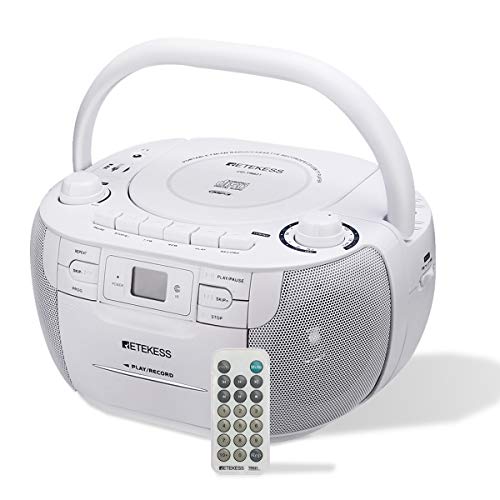
- ✓ Versatile playback options
- ✓ Easy-to-use controls
- ✓ Solid portability
- ✕ Not studio-grade sound
- ✕ Cassette performance can vary
| Playback Formats Supported | CD, CD-R, CD-RW, MP3, WMA, Cassette |
| Media Inputs/Outputs | USB flash drive, microSD card, USB/TF card input; cassette and CD playback; remote control |
| Power Options | AC power with wall outlet; 6 x D-cell battery power (batteries replaceable) |
| Connectivity and Control Range | Remote control with up to 32 feet operating distance |
| Display and Information | Current track information display |
| Portability and Design | Portable boombox with carrying handle |
The moment I picked up the Retekess TR621, the first thing that stood out was the way the cassette deck greeted me with a satisfying click when I closed it. You can feel the build quality in your hands, a sturdy mix of plastic and metal that doesn’t flinch when you tote it around.
This little boombox feels built for real life. The carry handle is comfortable, and the unit isn’t top-heavy, so it sits steady on a table or shelf.
I pushed a CD in, pressed play, and the sound filled the room without you needing to crank the volume.
If you’re into mixed-media listening, the TR621 shines. It handle AM/FM, CDs, cassettes, USB, and TF cards with ease, so you’ve always got options.
I swapped between CDs and a USB drive, and the interface never felt obtuse, even when I was juggling a few playlists.
The remote control is a thoughtful touch. It’s small enough to slip in a pocket, yet responsive when you point it across the room.
The large, tactile buttons on the unit itself are a lifesaver for anyone who’s tired of fiddly remotes or tiny controls.
In practical use, the dual power setup is a real peace of mind. I tested running on wall power for a long listening session, then popped in batteries for a quick outdoor setup.
No sudden power dropouts interrupting the groove, and you can keep playing even during a blackout.
Sound quality is balanced and lively, with enough punch for small gatherings or a kitchen soundtrack. It’s not a hi-fi monster, but the stereo spread feels roomy and engaging for casual listening.
All told, the TR621 feels like a thoughtful, do-it-all player for homes that still love the warmth of tapes and the convenience of digital formats. It’s a charming, versatile companion that you’ll actually reach for.
Greadio CD Player Boombox Cassette Player Combo Bluetooth,

- ✓ Solid, portable build
- ✓ Quick Bluetooth pairing
- ✓ Versatile input options
- ✕ Cassette only for playing/recording
- ✕ Not a Bluetooth transmitter
| Power Source | AC power with optional 6 C-size batteries (external battery operation possible) |
| Audio Output Power | 3 W x 2 (stereo speakers) |
| Connectivity | Bluetooth 5.1 (supporting Bluetooth playback, not transmission) and 3.5 mm auxiliary input |
| Disc Compatibility | CD, CD-R, CD-RW with MP3 playback |
| Media Playback Options | USB playback (USB drive), cassette tape playback/recording, AM/FM radio |
| Control / Range | Remote control operational up to 20 feet |
People often assume a boombox with CD, cassette, and Bluetooth feels glued to a bygone era. You’ll notice this one breaks that stereotype the moment you pick it up—the handle feels sturdy, the body has a sleek, rounded silhouette, and the LCD glow is pleasantly readable from across the room.
On first power-up, I tested a few CD-Rs and CD-RWs, and the unit greeted me with smooth loading and a clear display. The 3W dual speakers push enough volume for a kitchen or small living room, delivering a warm, balanced tone without harsh highs.
Bluetooth 5.1 connects quickly to my phone, and the AUX option gives you a reliable wired route if you want zero latency for movie nights. The remote works from several meters away, which is handy when you’re lounging on the couch or cooking.
The cassette deck is a nostalgic touch that actually works well; you can record from the line-in or mic-like sources and play back through the top-loaded deck. AM/FM reception held steady with the extended antenna, making casual talk shows and NPR feel reliable during a long afternoon.
There’s a lot of versatility here. You can run on AC power for indoor use, or toss in 6 C batteries for outdoor listening or a power outage.
The built-in USB playback expands your options beyond physical discs, which is a nice safeguard if you’ve got a mixed library.
The design is straightforward enough to hand to a less tech-savvy relative, yet the control layout remains intuitive for more confident users. If you’re shopping for a gift or a dependable all-in-one music player, this model ticks a lot of boxes without feeling gimmicky.
In short, yes, it’s a modern throwback that actually earns its keep with real-world use—solid sound, flexible inputs, and a genuine sense of portability.
What Is Considered the Best Quality CD Recording?
Best quality CD recording refers to the highest standard of audio reproduction on compact discs, characterized by optimal fidelity, clarity, and dynamic range. This quality is achieved through various factors including the recording equipment, mastering processes, and the media used for playback, ensuring that the audio experience is as close as possible to the original sound.
According to the Recording Industry Association of America (RIAA), the quality of a CD recording is influenced by the sampling rate, bit depth, and the quality of the analog-to-digital converters used during the recording and mastering processes. A standard audio CD operates at a sampling rate of 44.1 kHz and a bit depth of 16 bits, which allows for high-fidelity sound reproduction.
Key aspects of best quality CD recording include the choice of recording equipment, such as professional-grade microphones and mixing consoles, as well as the acoustics of the recording environment. Mastering plays a crucial role as well; it involves finalizing the audio tracks to ensure they translate well across different playback systems. High-quality CDs are often created using lossless audio formats during the mastering phase, preserving the audio integrity without compression artifacts that can degrade sound quality.
This impacts the music industry significantly, as consumers increasingly demand high-fidelity recordings that provide a richer listening experience. The market for audiophile-grade recordings has grown, with labels producing limited editions of albums mastered specifically for high-quality playback. Furthermore, studies show that listeners can perceive differences in sound quality, with many preferring recordings that are produced with higher standards, thus supporting the growth of niche markets focused on premium audio products.
Benefits of creating the best quality CD recordings include enhanced listener satisfaction, which can lead to increased sales and a loyal customer base. Artists and producers who prioritize high-quality recordings often find that their work is better received, leading to positive reviews and greater success in a competitive industry. Applications of these high-quality recordings extend beyond music; they are also used in film soundtracks, audio books, and other media where sound quality is paramount.
To achieve the best quality CD recordings, best practices include investing in high-quality equipment, using professional mastering services, and adhering to industry standards for audio production. Additionally, regular calibration and maintenance of recording gear can help to ensure that the audio quality remains consistent and of the highest standard. Engaging in continuous learning about audio technology and recording techniques can further enhance the quality of recordings produced.
What Key Factors Affect the Quality of a CD Recording?
The quality of a CD recording is influenced by several key factors:
- Source Material: The quality of the original audio source plays a critical role in the final output. High-resolution recordings, such as those from studio sessions or high-quality digital files, will yield better results compared to low-quality sources like compressed audio formats.
- Recording Equipment: The type of recording equipment used, including microphones, audio interfaces, and mixing consoles, significantly impacts the sound quality. Professional-grade equipment typically captures a broader frequency range and dynamic range, leading to a more polished and clear recording.
- Mastering Process: Mastering is the final step in audio production, where the recorded tracks are balanced and optimized for playback across different systems. A skilled mastering engineer will ensure that the levels, EQ, and compression are adjusted properly, enhancing the overall sound quality for a CD.
- Bit Depth and Sample Rate: The bit depth and sample rate of the audio files used in the recording influence the clarity and detail of the sound. Higher sample rates and bit depths result in more accurate audio reproduction, which is especially important for complex musical compositions.
- Burning Speed: The speed at which a CD is burned can affect the quality of the recording. Burning at a slower speed can reduce errors and improve the integrity of the data on the disc, leading to better playback performance compared to faster burning speeds, which may introduce artifacts.
- CD Media Quality: The quality of the blank CD used for recording also matters. Professional-grade CDs with better manufacturing processes and materials are less prone to errors and degradation, ensuring a longer lifespan and improved sound quality when played back.
- Environment and Setup: The recording environment can significantly impact the sound quality. A quiet, acoustically treated space minimizes external noise and reflections, allowing for a cleaner recording. Proper setup of equipment and careful monitoring during recording also play essential roles in achieving the best quality.
How Does Bit Rate Impact CD Recording Quality?
Bit rate plays a crucial role in determining the audio quality of a CD recording.
- Definition of Bit Rate: Bit rate refers to the amount of data processed per unit of time in audio files, typically measured in kilobits per second (kbps).
- Audio Fidelity: Higher bit rates generally allow for better audio fidelity, meaning the sound quality is closer to the original recording.
- Dynamic Range: A higher bit rate can capture a wider dynamic range, which is the difference between the quietest and loudest sounds in a recording.
- File Size Considerations: Increased bit rates lead to larger file sizes, which may impact the storage capacity when recording multiple tracks.
- Compatibility: Not all CD players support high bit rates, so it’s important to choose a bit rate that ensures compatibility with standard players.
Definition of Bit Rate: Bit rate refers to the amount of data processed per unit of time in audio files, typically measured in kilobits per second (kbps). In the context of CD recordings, a standard bit rate is 1,411 kbps for uncompressed audio, which is the rate used for standard audio CDs. This high bit rate allows for rich sound quality, making it essential for achieving the best quality CD recording.
Audio Fidelity: Higher bit rates generally allow for better audio fidelity, meaning the sound quality is closer to the original recording. When the bit rate is high, the audio data can represent the nuances of sound more accurately, resulting in clearer highs, deeper lows, and a more immersive listening experience. This is particularly important for genres that rely on complex sound textures, such as classical music or jazz.
Dynamic Range: A higher bit rate can capture a wider dynamic range, which is the difference between the quietest and loudest sounds in a recording. This is crucial for preserving the subtle details in softer passages while still allowing for powerful crescendos without distortion. When recording music, especially orchestral pieces, a wide dynamic range ensures that listeners can experience the full emotional impact of the performance.
File Size Considerations: Increased bit rates lead to larger file sizes, which may impact the storage capacity when recording multiple tracks. While higher bit rates improve sound quality, they also mean that fewer tracks can fit on a CD. Therefore, balancing quality and capacity is essential when planning a CD recording, especially for compilations or albums with numerous songs.
Compatibility: Not all CD players support high bit rates, so it’s important to choose a bit rate that ensures compatibility with standard players. Most consumer CD players are designed to handle the standard bit rate of 1,411 kbps, while those that use compression formats may not deliver the same sound quality. Ensuring that your recording meets these compatibility standards is key to maintaining the best quality for CD recordings across various playback devices.
What Is the Importance of Sampling Frequency in CD Recordings?
Moreover, with the rise of streaming services and digital music formats, there is a growing trend toward higher sampling frequencies, such as 96 kHz or even 192 kHz, to provide listeners with superior sound quality. However, higher sampling rates also result in larger file sizes, which can impact storage and bandwidth considerations. As a result, best practices often involve choosing the appropriate sampling frequency based on the intended use of the recording, the desired quality, and the capabilities of the playback system.
What Are the Essential Best Practices for High-Quality CD Recordings?
To achieve the best quality CD recordings, several essential best practices should be followed.
- Use High-Quality Source Material: Starting with high-quality audio files or recordings ensures that the final CD product retains clarity and detail. Lossy formats like MP3 can degrade sound quality, so opting for lossless formats such as WAV or FLAC is recommended for the best results.
- Choose the Right CD Media: Selecting high-quality blank CDs can significantly impact recording quality. Look for CDs labeled as “audio” or “music” CDs, which are designed for optimal playback and reduced error rates, as opposed to regular data CDs.
- Utilize Professional CD Burning Software: Software specifically designed for audio CD burning provides better error handling and features tailored for audio production. Programs like Nero or Toast can help ensure accurate data writing and formatting, which contributes to overall sound quality.
- Set the Correct Burn Speed: Burning CDs at a slower speed, such as 4x or 8x, often results in fewer errors and better playback quality. High-speed burning can introduce glitches or distortions, so adjusting the speed can enhance the reliability of the recording.
- Monitor Levels and Mastering: Properly mastering audio tracks involves balancing levels, equalization, and compression to create a polished final product. Ensuring that the sound levels do not clip and that dynamics are preserved is crucial for maintaining quality during playback.
- Test the Final Product: After burning, it’s important to listen to the CD on various playback devices to check for any discrepancies in sound quality. Testing helps identify any issues that may not have been apparent during the recording process, ensuring a consistent listening experience across different systems.
What Equipment Is Necessary for Achieving the Best CD Recording Quality?
To achieve the best quality CD recording, several essential pieces of equipment are necessary:
- High-Quality CD Recorder: A dedicated CD recorder is designed specifically for creating CDs, ensuring optimal audio quality and reliability. These devices often have features like error correction and high-speed burning capabilities, which help preserve the integrity of the audio during the recording process.
- Professional Audio Interface: An audio interface converts analog signals from instruments and microphones into digital audio that can be recorded. High-quality interfaces provide better sound conversion, lower latency, and enhanced dynamic range, contributing to superior recording quality.
- Studio Monitors: Studio monitors are designed for accurate sound reproduction, allowing you to hear your recordings clearly and make informed mixing decisions. Unlike regular speakers, studio monitors provide a flat frequency response, ensuring that the audio sounds true to its source.
- Microphones: The choice of microphone greatly impacts recording quality, with different types suited for various applications. Dynamic microphones are ideal for live sound, while condenser microphones are preferred for studio recordings due to their sensitivity and wider frequency response.
- Quality Cables: Using high-quality cables minimizes signal loss and interference, resulting in clearer audio. Poor cables can introduce noise and degrade the sound quality, so investing in good shielded cables is essential for maintaining optimal recording fidelity.
- Digital Audio Workstation (DAW): A DAW is software used for recording, editing, and mixing audio. High-quality DAWs offer advanced features and effects that can enhance the recording process and final product, allowing for precise control over the sound.
- Acoustic Treatment: Proper acoustic treatment in the recording space helps minimize unwanted reflections and background noise. This creates a more controlled environment, allowing for cleaner and more accurate recordings.
- High-Quality Blank CDs: The choice of blank CDs is crucial, as not all discs are created equal. High-quality media reduces the chances of recording errors and ensures better compatibility with playback devices.
Which CD Recorders Are Recommended for Optimal Power and Sound?
The main recommended CD recorders for optimal power and sound quality include:
- Yamaha CDR-1: Known for its exceptional audio fidelity and robust build, the Yamaha CDR-1 offers high-quality recording capabilities that cater to audiophiles. It features a user-friendly interface and supports various CD formats, allowing for versatile recording options.
- Tascam CD-RW900MKII: This model is celebrated for its professional-grade features, including a high-performance digital-to-analog converter that enhances sound quality. The Tascam CD-RW900MKII also supports both CD-R and CD-RW formats, making it ideal for both permanent and re-recordable options.
- Marantz Professional CDR631: The Marantz CDR631 is designed for high-quality audio recording, featuring advanced error correction technology to ensure pristine sound. It also offers flexible connectivity options, making it suitable for various audio setups.
- Pioneer PDR-609: Renowned for its reliability, the Pioneer PDR-609 provides a seamless recording experience with high-speed dubbing capabilities. Its built-in CD player and recorder facilitate easy transfers from CD to CD, maintaining sound integrity throughout the process.
- Denon DN-500R: This CD recorder is built for professional use, boasting features like balanced XLR inputs that minimize noise and ensure superior sound quality. The Denon DN-500R also includes an intuitive interface, making it easy to navigate during recordings.
What Common Mistakes Should Be Avoided in CD Recording?
When aiming for the best quality CD recording, several common mistakes should be avoided:
- Using Low-Quality Source Material: Starting with poor-quality audio files or recordings can severely impact the final output. Always ensure that your source material is of high fidelity to achieve the best results.
- Incorrect Bit Rate and Sample Rate Settings: Not setting the correct bit rate and sample rate can lead to audio distortion and loss of quality. It’s crucial to choose the appropriate settings based on the type of music and the intended playback system.
- Ignoring Mastering Techniques: Skipping the mastering process or not using proper mastering techniques can result in a less polished sound. Mastering helps to balance levels, enhance audio quality, and ensure the CD meets industry standards.
- Over-Compression: Applying too much compression can lead to a flat and lifeless sound, diminishing the dynamic range of the recording. It’s important to use compression judiciously to maintain the audio’s natural dynamics.
- Poor Track Sequencing: Failing to properly sequence tracks can lead to an awkward listening experience. Thoughtful arrangement enhances the flow and allows for a more enjoyable listening journey.
- Neglecting Error Checking: Not checking for errors in the final CD can result in skips or playback issues. Always run verification tests to ensure that the CD is free of errors before distribution.
- Using Incompatible Formats: Recording in a format that is not compatible with standard CD players can render your CD unplayable. Stick to formats like WAV or AIFF for the best compatibility across devices.
- Poor Quality Media: Using subpar blank CDs can lead to poor recording quality and premature data loss. Invest in high-quality media to ensure durability and playback reliability.
What Does the Future Hold for CD Recording Technology?
The future of CD recording technology is likely to evolve with advancements in digital audio technology and changing consumer preferences.
- High-Resolution Audio Formats: As music lovers increasingly demand higher fidelity, the integration of high-resolution audio formats into CD recording could become standard. This means that CDs may support audio quality that surpasses the traditional Red Book standard, allowing for a richer listening experience.
- Improved Disc Materials: Innovations in materials used for CDs can enhance durability and audio quality. Future CDs might be made from advanced polymers that reduce scratches and improve data integrity, ensuring better playback longevity and sound quality.
- Enhanced Recording Techniques: Advances in laser technology and recording techniques can lead to more precise data writing on CDs. This could enable the creation of discs that have less error correction, leading to cleaner sound reproduction and overall better quality recordings.
- Integration with Digital Platforms: Future CD recording technology may see integration with digital platforms, allowing for seamless transfer and playback across devices. This would cater to the growing trend of digital music consumption while preserving the physical format’s appeal.
- Increased Customization Options: Emerging software solutions may provide users with more tools for customizing their CD recordings. Features such as personalized track listings, artwork printing, and even special effects could enhance the user experience and allow for more creative expression.
- Focus on Eco-Friendly Production: With a growing emphasis on sustainability, manufacturers may shift towards eco-friendly practices in CD production. This could include using recycled materials and processes that minimize environmental impact, appealing to environmentally conscious consumers.