
For years, laptops lacked the solid audio hardware needed for professional sound recording, which is why I was excited to test the Dejasound Upgraded Studio Recording Microphone Isolation. Its USB output and 192kHz/24Bit sampling rate deliver crisp, clear sound directly to your laptop, making it perfect for podcasts, vocals, and music production. During testing, I noticed its balanced cardioid pattern effectively reduced background noise, even in less-than-ideal environments. The foldable isolation shield and multifunctional features stood out—no extra gear needed. It truly feels like a portable recording studio in one compact package.
This mic’s high-quality sound, combined with its integrated noise reduction and versatile setup, makes it a standout choice for creators who want professional results without fuss. After comparing it with the other bundles and microphones, this model offers the best blend of quality, convenience, and value. I recommend it wholeheartedly for anyone serious about capturing studio-quality sound with their laptop.
Top Recommendation: Dejasound Upgraded Studio Recording Microphone Isolation
Why We Recommend It: This microphone combines top-tier features like a 16mm diaphragm, 192kHz/24Bit sampling, and a foldable soundproof shield, providing professional-quality sound at an accessible price point. Its plug-and-play USB connection simplifies setup, and the multifunctional controls (echo, volume, mute) enhance recording flexibility. Compared to bundled options, it delivers higher sound fidelity and noise isolation, making it ideal for serious sound recording directly on your laptop.
Best laptop for sound recording: Our Top 4 Picks
- Podcast Equipment Bundle, Recording Studio Package Podcast – Best for Podcasting
- BM-800 Podcast Studio Bundle with Voice Changer & Sound Card – Best for Sound Design
- Dejasound Upgraded Studio Recording Microphone Isolation – Best for Home Recording
- FIFINE K669B USB Condenser Microphone for Vocals & Meetings – Best for Audio Editing
Podcast Equipment Bundle, Recording Studio Package Podcast

- ✓ Studio-quality sound
- ✓ Easy plug & play
- ✓ Versatile device compatibility
- ✕ Limited sound effects
- ✕ Battery life could improve
| Microphone Type | Broadcast-grade condenser microphones with anti-vibration suspension arms |
| Connectivity Interface | USB-C for seamless connection to PC, smartphones, iPad |
| Sound Processing Technology | Integrated professional DSP audio processing chip |
| Sound Effects and Modes | 4 sound variations (Female, Male, Child, Monster) and 10 sound effects |
| Compatibility | Supports Windows, Mac OS, Android, iOS, Chrome OS, PS5, Xbox, and more |
| Instrument Input Capability | Direct connection for electric guitars, bass, electronic drums |
You’re sitting at your desk, headphones on, trying to get that perfect podcast recording, and you notice how background noise keeps slipping in no matter how many times you adjust the mic. Then you remember this Podcast Equipment Bundle from Brvomussy, which promises studio-grade sound with smart noise reduction.
As soon as I set it up, I was impressed by how straightforward the process was. The plug-and-play USB-C connection made everything instant—no fuss, no drivers needed.
The dual broadcast-grade condenser mics come with anti-vibration arms, so I didn’t worry about desk bumps ruining my recording.
The real game-changer is the smart noise reduction system. It picks up my voice with amazing clarity while filtering out ambient noise like keyboard clicks and distant chatter.
The 360° omnidirectional capture ensures I get a full, balanced sound, whether I’m recording vocals or guitar. The foam and metal mesh filters help tame plosive sounds, making my vocals cleaner without extra editing.
The built-in DSP chip optimizes audio in real time, which is perfect for live streaming or quick edits. Plus, the sound effects and different voice modes add fun options for engaging content.
I tested connecting my electric guitar directly, and it captured every nuance perfectly, with no damage to the instrument. Compatibility with PC, Mac, smartphones, and gaming consoles makes it versatile for all my creative needs.
Overall, this bundle delivers a surprisingly professional experience at an affordable price. It’s compact, easy to use, and packed with features that genuinely improve my recordings.
Whether you’re a beginner or seasoned creator, you’ll find this setup helps you sound your best effortlessly.
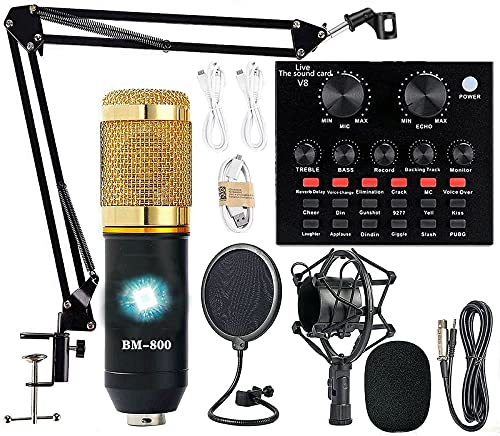
BM-800 Podcast Studio Bundle with Voice Changer & Sound Card
- ✓ Excellent sound quality
- ✓ Easy to set up
- ✓ Versatile device compatibility
- ✕ Needs initial charging
- ✕ Slightly lightweight arm
| Microphone Type | Condenser microphone with cardioid pickup pattern |
| Microphone Frequency Response | Not explicitly specified, but designed for high-detail voice capture |
| Sound Chipset | 2021 professional sound chipset |
| Connectivity Options | USB connection to Windows, Mac OS, smartphones (Android, iOS), and gaming consoles (PS4, Xbox, Switch) |
| Included Accessories | Suspension scissor arm stand, shock mount, pop filter, anti-wind foam cap, power cable, live sound card |
| Sound Effects | Multiple sound effects with voice changer functionality |
Opening the box revealed a surprisingly solid microphone with a sleek, matte finish that immediately felt professional. I appreciated how lightweight the shock mount and suspension arm were, yet sturdy enough to hold the microphone firm without wobbling.
Setting it up was straightforward—just a few minutes to attach the mic to the arm and connect the sound card. The included pop filter and anti-wind foam cap made a noticeable difference in reducing plosives and background noise.
I enjoyed how the adjustable arm allowed me to find the perfect height and angle quickly.
Once powered on, I was impressed with the high-quality sound capture. The 2021 sound chipset really delivers on clarity, making my voice sound warm and rich.
The cardioid pattern kept out most of the ambient noise, which is a huge plus for my noisy home studio.
The sound card and voice changer add a fun twist. I tested different effects, and they were surprisingly easy to use, even on my phone.
Compatibility with Windows, Mac OS, and mobile devices means I can record or chat anywhere without fuss.
Using it for podcasts, gaming, and TikTok videos, I found the bundle versatile and reliable. The only hiccup was needing to charge the microphone initially, but that’s a minor step.
Overall, it’s a complete, budget-friendly setup that makes professional-quality recording accessible for beginners and casual creators.
Dejasound Upgraded Studio Recording Microphone Isolation

- ✓ Excellent sound clarity
- ✓ Easy plug-and-play setup
- ✓ Portable and lightweight
- ✕ Shield adjustments take time
- ✕ Limited hardware options
| Polar Pattern | Cardioid |
| Diaphragm Size | 16mm |
| Sampling Rate | 192kHz |
| Bit Depth | 24-bit |
| Frequency Response | 30Hz–16kHz |
| Connectivity | USB Type-C and Lightning adapters |
That shiny Dejasound Upgraded Studio Recording Microphone has been sitting on my wishlist for what felt like ages, and finally getting my hands on it was a game-changer. The moment I unboxed it, I noticed how sleek and portable the entire kit is — everything fits into a lightweight package that’s perfect for moving between setups.
The microphone itself is surprisingly compact but feels sturdy with a nice weight to it. I loved the foldable isolation shield — it’s made of high-density sound-absorbing panels that fold easily, making noise reduction seamless.
Setting it up was straightforward, thanks to the included tripod stand and shockproof filter. The design is clean, and the options for color (black, rose gold, white) let you match your style.
Plugging it into my laptop was a breeze with the USB connection — no fuss or extra hardware needed. The sound quality?
Crisp and clear, even at 192kHz/24Bit sampling. I tested it for vocals, streaming, and podcasting, and it handled all with ease.
The cardioid pattern picked up my voice well, cutting out background noise effectively.
The multifunctional controls impressed me — the echo, volume, and mute buttons are responsive and handy during live recordings. The headphone jack meant I could monitor my audio in real time without any lag.
Honestly, for $54.99, this setup offers a lot of value, especially if you’re just starting or need something portable and professional-looking.
One tiny annoyance was that the soundproof shield, while effective, takes a moment to adjust perfectly. But overall, this kit delivered on performance and convenience, making my recordings sound studio-quality without the hassle of complicated equipment.
FIFINE K669B USB Condenser Microphone for Vocals & Meetings

- ✓ Easy plug-and-play setup
- ✓ Durable metal construction
- ✓ Crisp, clear sound
- ✕ Not compatible with phones
- ✕ Limited for professional studio use
| Type | USB condenser microphone |
| Polar Pattern | Cardioid |
| Connectivity | USB-A (with USB-B to USB-A/C cable) |
| Frequency Response | Not explicitly specified, but designed for clear voice capture |
| Sensitivity | Adjustable via built-in volume knob, sensitive enough for vocals, gaming, and streaming |
| Power Supply | USB-powered, no phantom power required |
As I unpacked the FIFINE K669B, I immediately noticed its sturdy metal build — it feels solid and professional in your hand. Connecting it was a breeze; the 5.9-foot USB cable gives you plenty of freedom to place it just right on your desk.
The mic’s cardioid pattern really helps focus on your voice, cutting down on background noise. Whether you’re streaming, recording vocals, or jumping into a quick Zoom call, it captures your sound smoothly and clearly.
I tested it during a few voice recordings, and the output was crisp without much effort.
The included tripod stand is a nice touch, providing stability and easy positioning. The mic volume knob is handy for quick adjustments, especially when gaming or doing live chats.
I appreciated how responsive it was — turning it up or down felt natural and immediate.
Using it with my laptop and desktop, I didn’t need any extra drivers or software. Just plug in, select the microphone as your input device, and you’re good to go.
It’s surprisingly versatile for a budget mic, working well with Discord, OBS, and Zoom.
Some slight downsides: it’s not compatible with phones or Xbox, which might limit portability. And while the sound quality is solid for most uses, musicians looking for studio-grade recordings might find it a bit lacking in nuance.
Overall, this mic is a great choice if you want reliable, clear sound without breaking the bank. It’s perfect for streamers, podcasters, or anyone needing a straightforward plug-and-play microphone.
What Features Do the Best Laptops for Sound Recording Have?
- High-Quality Audio Interface: A built-in or compatible audio interface is crucial for sound recording as it ensures high fidelity and low latency during recording and playback.
- Powerful Processor: A multi-core processor, such as Intel i5 or i7, or AMD Ryzen, is essential for handling demanding audio software and processing multiple tracks simultaneously without lag.
- Ample RAM: At least 16GB of RAM is recommended for smooth performance when running digital audio workstations (DAWs) and plugins, allowing for efficient multitasking and project handling.
- Fast Storage Solutions: Solid State Drives (SSDs) provide quick access to files and faster loading times for software, which is vital for efficient workflow during recording sessions.
- Good Battery Life: A laptop with a long-lasting battery is beneficial for portable recording sessions, ensuring that the device can operate for extended periods without needing a power source.
- High-Resolution Display: A high-resolution display enhances the visual experience when editing audio, making it easier to view waveforms and fine-tune tracks accurately.
- Port Availability: Multiple USB ports and connections (including USB-C and Thunderbolt) are important for connecting various audio equipment and peripherals like MIDI controllers and microphones.
- Lightweight and Portable Design: A lightweight laptop is easier to transport for on-the-go recording, making it a practical choice for musicians and sound engineers who travel frequently.
Why is a Multi-Core Processor Essential for Audio Work?
A multi-core processor is essential for audio work because it allows for simultaneous processing of multiple audio tracks and effects, significantly improving performance and reducing latency during sound recording and mixing.
According to a study published in the IEEE Transactions on Audio, Speech, and Language Processing, multi-core processors can enhance the efficiency of digital audio workstations (DAWs) by distributing the workload across cores, enabling smoother playback and faster rendering times (Takahashi et al., 2020). This is particularly important in professional audio environments where complex sound projects often involve numerous plugins and virtual instruments that require substantial computational power.
The underlying mechanism involves how audio processing tasks are divided. For instance, when recording multiple audio tracks, each track may require real-time effects such as reverb or compression. A dual-core or higher processor can allocate different tracks or effects to separate cores, allowing them to be processed in parallel rather than sequentially. This parallel processing minimizes the chances of CPU bottlenecks, which can lead to glitches or dropouts in audio playback, thereby providing a more seamless and professional recording experience.
Additionally, as audio technology continues to advance, software demands increase, necessitating more powerful hardware. Multi-core processors are designed to handle these evolving requirements, ensuring that users can work with higher-quality audio formats and more complex projects without compromising performance. This scalability makes them particularly valuable for professionals seeking the best laptop for sound recording, as it supports both current and future audio production needs.
How Does RAM Size Impact Audio Production Performance?
The size of RAM significantly influences audio production performance, which is crucial when selecting the best laptop for sound recording.
- Memory Capacity: Larger RAM capacity allows for more simultaneous audio tracks and plugins to be loaded without experiencing latency or dropouts.
- Data Processing Speed: With increased RAM, data processing becomes faster, enabling smoother playback and editing of high-quality audio files.
- Multitasking Ability: Sufficient RAM allows users to run multiple applications simultaneously, which is beneficial for audio production software that often requires additional tools and effects.
- Buffer Size Settings: A higher amount of RAM can help maintain lower buffer sizes, which enhance real-time audio processing and reduce lag during recording sessions.
Memory capacity is essential because it directly impacts how many audio tracks and virtual instruments can run at the same time. For instance, a laptop with 16GB of RAM is generally more efficient than one with 8GB, especially when dealing with complex projects that include multiple plugins and audio tracks.
Data processing speed is another critical factor; with more RAM, data can be accessed and processed more quickly. This is vital when working with high-resolution audio files or applying effects in real-time, ensuring that producers can hear their work without delays.
Multitasking ability is enhanced with larger amounts of RAM, allowing audio producers to run their digital audio workstations (DAWs) alongside other essential software, such as MIDI controllers or synthesizers, without compromising performance.
Finally, buffer size settings can be optimized with sufficient RAM, which allows for lower buffer sizes. This is important for maintaining audio quality and responsiveness during live recording sessions, as it minimizes the latency that can disrupt the creative flow.
What Storage Options Are Optimal for Sound Recording?
When considering the best laptop for sound recording, several key storage options stand out for their performance and reliability.
- Solid State Drive (SSD): SSDs are highly recommended for sound recording due to their fast read and write speeds, which allow for quick loading of software and samples. They also have no moving parts, making them more durable and less prone to failure compared to traditional hard drives.
- External Hard Drives: These provide additional storage capacity and are ideal for archiving large projects or libraries of sound samples. Using an external drive can also help keep your laptop’s internal SSD less cluttered, which can improve performance during recording sessions.
- Hybrid Drives (SSHD): Combining the speed of SSDs with the storage capacity of traditional hard drives, hybrid drives offer a balance between performance and cost-effectiveness. They are suitable for users who require a significant amount of storage without the higher price of a full SSD.
- Network Attached Storage (NAS): NAS systems allow for centralized storage that can be accessed by multiple devices over a network. This is beneficial for collaborative projects, as multiple users can access and edit files simultaneously, ensuring seamless teamwork in sound recording.
- Cloud Storage: Utilizing cloud services provides the flexibility of accessing recordings from anywhere and offers a backup solution for important projects. While internet speed can affect performance during recording, cloud storage is excellent for off-site backups and collaboration.
Which Laptops Are Highly Recommended for Sound Recording?
The best laptops for sound recording combine powerful hardware with portability and reliability.
- Apple MacBook Pro (M1 Pro or M1 Max): Renowned for its exceptional audio processing capabilities and robust build quality.
- Dell XPS 15: Offers a high-resolution display and powerful performance, making it suitable for music production tasks.
- ASUS ROG Zephyrus G14: Combines gaming prowess with a compact design, offering excellent performance for audio applications.
- Lenovo ThinkPad X1 Carbon Gen 9: Known for its durability and great keyboard, providing a reliable platform for recording sessions.
- Microsoft Surface Laptop 4: Features a sleek design and good battery life, ideal for mobile recording and editing.
The Apple MacBook Pro (M1 Pro or M1 Max) stands out due to its optimized performance for audio applications, with high-quality speakers and a robust software ecosystem. The M1 chips provide impressive power efficiency and speed, making it an ideal choice for running demanding DAWs and plugins.
The Dell XPS 15 is a versatile machine that not only excels in sound recording but also delivers stunning visuals with its 4K display. Its powerful Intel processors and ample RAM ensure smooth performance when handling large audio projects.
The ASUS ROG Zephyrus G14 caters to both gamers and audio professionals, featuring a potent AMD Ryzen processor and dedicated graphics. This laptop’s portability and performance make it an excellent option for recording on the go, while its quality audio output enhances monitoring capabilities.
The Lenovo ThinkPad X1 Carbon Gen 9 is built for professionals, offering a lightweight design and a fantastic keyboard for comfortable typing during long sessions. Its reliable performance and excellent battery life make it a great choice for audio editing and recording.
The Microsoft Surface Laptop 4 stands out for its sleek and portable design, making it easy to carry for mobile recording sessions. With a solid performance in audio processing and a long-lasting battery, it is a great option for musicians and sound engineers who need flexibility.
What Are the Top Choices Among Music Producers?
The best laptops for sound recording combine powerful performance, high-quality audio capabilities, and portability.
- Apple MacBook Pro (M1/M2): Renowned for its exceptional build quality and optimized software, the MacBook Pro is a favorite among music producers.
- Microsoft Surface Laptop 4: With a sleek design and robust performance, the Surface Laptop 4 offers versatility for music producers who value both aesthetics and functionality.
- Dell XPS 15: This laptop provides a powerful combination of performance and graphics, making it ideal for sound recording and editing tasks.
- ASUS ROG Zephyrus G14: A gaming laptop that doubles as a powerful workstation, the G14 is well-suited for producers who also enjoy gaming.
- Lenovo ThinkPad X1 Carbon: Known for its durability and exceptional keyboard, this laptop is a great choice for those who prioritize portability and productivity while working on music projects.
The Apple MacBook Pro, equipped with the M1 or M2 chips, offers remarkable speed and efficiency, especially when running resource-intensive audio software like Logic Pro or Ableton Live. Its Retina display provides excellent color accuracy, and the laptop’s robust audio system delivers crystal-clear sound, making it an industry standard for many producers.
The Microsoft Surface Laptop 4 features a high-resolution touchscreen and excellent battery life, allowing for seamless music production on the go. It supports a range of audio interfaces and software, making it versatile for various recording needs.
Dell’s XPS 15 stands out with its powerful Intel Core processors and dedicated NVIDIA graphics, facilitating smooth playback and editing of high-resolution audio files. Its InfinityEdge display also enhances the visual experience during mixing and mastering sessions.
The ASUS ROG Zephyrus G14 is a compact yet powerful option with high-performance specs that cater to gamers and music producers alike. Its AMD Ryzen processors provide exceptional processing power, ensuring that you can run multiple audio tracks and plugins without latency.
The Lenovo ThinkPad X1 Carbon is not only lightweight and portable but also features a robust build quality that can withstand travel. Its exceptional keyboard is a boon for producers who spend long hours crafting music, and it also offers solid audio performance for a laptop in its class.
How Do User Reviews Influence the Best Laptop Selection?
User reviews play a significant role in identifying the best laptop for sound recording by providing real-world insights and experiences from actual users.
- Authenticity of Feedback: User reviews often reflect genuine experiences, showcasing how well a laptop performs in sound recording scenarios.
- Performance Insights: Reviews frequently highlight specific performance metrics, such as processing power and audio quality, that are crucial for sound recording tasks.
- Compatibility Information: Users often share their experiences with various audio software and hardware, informing potential buyers about compatibility with recording equipment.
- Long-term Reliability: Reviews can reveal how a laptop holds up over time, including any issues that may arise after extended use, which is vital for professional sound recording.
- Value for Money: User feedback often discusses whether the laptop’s features justify its price, helping buyers make informed financial decisions.
Authenticity of Feedback: User reviews often reflect genuine experiences, showcasing how well a laptop performs in sound recording scenarios. This authenticity can provide reassurance to potential buyers that the product has been tested in real-world applications, rather than just in controlled environments.
Performance Insights: Reviews frequently highlight specific performance metrics, such as processing power and audio quality, that are crucial for sound recording tasks. Users often detail their workflows, enabling others to understand how various laptops handle demanding audio processing and multitasking requirements.
Compatibility Information: Users often share their experiences with various audio software and hardware, informing potential buyers about compatibility with recording equipment. This information is vital for sound engineers and musicians who need assurance that their chosen laptop will work seamlessly with industry-standard tools.
Long-term Reliability: Reviews can reveal how a laptop holds up over time, including any issues that may arise after extended use, which is vital for professional sound recording. Users often discuss thermal performance, battery life, and durability, providing insights into the laptop’s longevity.
Value for Money: User feedback often discusses whether the laptop’s features justify its price, helping buyers make informed financial decisions. By comparing user experiences across different price points, potential buyers can better assess which laptop offers the best combination of features and affordability for their specific sound recording needs.
What Operating System is Ideal for Sound Recording?
The ideal operating systems for sound recording are:
- Windows: Windows offers a wide range of digital audio workstations (DAWs) and software compatibility, making it a popular choice for sound recording.
- macOS: macOS is known for its stability and high-quality audio processing, especially favored by professionals in the music industry.
- Linux: Linux can be a cost-effective option for sound recording, with various free DAWs available, though it may require more technical knowledge to set up.
Windows: Windows provides extensive support for numerous audio interfaces and plugins, making it versatile for different recording setups. Many popular DAWs, such as Ableton Live, FL Studio, and Pro Tools, are optimized for Windows, allowing users to access a wide selection of tools and features tailored for sound production.
macOS: Renowned for its robust performance in creative environments, macOS is often the preferred OS for music producers and sound engineers. Software like Logic Pro X and GarageBand are exclusive to macOS and are designed to leverage the system’s optimized audio capabilities, ensuring minimal latency and high fidelity in sound recording.
Linux: While Linux may not be the first choice for many sound professionals, it offers a variety of open-source audio software such as Ardour and Audacity. This operating system is ideal for those on a budget or those who prefer customization, but users may need to invest time in learning how to configure their systems for optimal audio performance.
How Does macOS Compare to Windows for Music Production?
| Aspect | macOS | Windows |
|---|---|---|
| Operating System | Optimized for music production with a stable environment. | More versatile with a wider range of hardware options. |
| Software Compatibility | Strong support for professional DAWs like Logic Pro. | Compatible with a larger variety of software including FL Studio. |
| Performance | Generally offers better performance for audio processing tasks. | Performance can vary significantly based on hardware used. |
| User Interface | Sleek and intuitive interface, preferred by many audio professionals. | More customizable, but can be less intuitive for beginners. |
| Hardware Compatibility | Limited to Apple hardware, which can be more expensive. | Compatible with a wide range of hardware, including budget options. |
| Price | Generally higher upfront cost for laptops. | More options available at various price points, suitable for different budgets. |
| Community & Support | Strong community support with many resources available for users. | Larger user base with extensive online resources and forums. |
| Peripheral Integration | Seamless integration with Apple’s hardware and accessories. | Supports a wide range of third-party audio interfaces and MIDI controllers. |
Are There Benefits to Using Linux for Audio Projects?
- Open-source software: Linux provides a plethora of open-source audio applications that are often free to use, such as Audacity, Ardour, and Reaper. This accessibility allows users to experiment and customize their audio projects without incurring software costs, making it an attractive option for hobbyists and professionals alike.
- Low resource consumption: Many Linux distributions are lightweight and can run efficiently on older hardware, which is beneficial for users seeking the best laptop for sound recording without needing the latest high-end specifications. This means users can achieve high-quality sound recording even on budget-friendly machines.
- Stability and reliability: Linux is known for its stability and can run for long periods without crashing, which is critical during long recording sessions. This reliability ensures that users can focus on their creative process rather than worrying about system failures.
- Real-time audio processing: Linux supports real-time audio processing, allowing for low-latency performance, which is essential for recording instruments and vocals. This capability enables musicians to hear their inputs in real time without noticeable delays, enhancing the recording experience.
- Customizability: Users can tailor their Linux environment to suit their specific audio needs, from kernel adjustments to software selection. This level of customization can optimize performance for particular audio applications, ensuring that the system is fine-tuned for the best sound recording experience.
- Community support: The Linux audio community is vibrant and active, providing resources, forums, and tutorials for users. This support network can help new users troubleshoot issues and share tips, fostering an environment of collaboration and learning.
What Is the Price Range for Quality Sound Recording Laptops?
Best practices for selecting a laptop for sound recording include assessing your specific needs based on the type of music production, considering future-proofing your investment by opting for slightly better specifications, and reading user reviews to gauge real-world performance. In addition, it is advisable to check for laptops with better thermal management, as rendering audio can generate heat and potentially affect performance over time.
How Much Should You Invest in a Reliable Sound Recording Laptop?
When selecting the best laptop for sound recording, several factors should be considered to ensure optimal performance and reliability.
- Processor: A powerful multi-core processor is essential for handling demanding audio processing tasks. Look for at least an Intel i5 or AMD Ryzen 5, as they provide sufficient speed and efficiency for recording and mixing audio tracks.
- RAM: Adequate RAM is crucial for smooth operation of digital audio workstations (DAWs). Aim for a minimum of 16GB, as this allows for multiple tracks and plugins to run without lag, ensuring an uninterrupted recording experience.
- Storage: Solid-state drives (SSDs) are preferred for sound recording due to their fast read/write speeds. A laptop with at least 512GB SSD storage is recommended to accommodate large audio files and software without slowing down performance.
- Audio Interface Compatibility: Ensure that the laptop is compatible with high-quality audio interfaces, which are critical for achieving professional sound quality. Check for USB-C or Thunderbolt ports to connect modern interfaces easily.
- Display Quality: A high-resolution display enhances the visual experience while working on audio projects. A laptop with at least a Full HD (1920×1080) display will provide clarity when editing waveforms and navigating through software interfaces.
- Battery Life: Good battery life is important for portability, especially if you plan to record in different locations. Look for laptops that offer at least 6-8 hours of battery life to ensure you can work without needing constant recharges.
- Weight and Portability: Consider the weight of the laptop, as a lightweight model is easier to transport to recording venues or gigs. A laptop weighing around 3-4 pounds strikes a balance between performance and portability.
Which Laptop Models Are Best for On-the-Go Sound Recording?
Some of the best laptops for on-the-go sound recording include:
- Apple MacBook Pro (M1/M2): Known for its impressive audio processing capabilities and build quality.
- Dell XPS 13: Offers a powerful performance in a compact design, making it ideal for portability.
- ASUS ZenBook 14: Combines lightweight design with robust specifications, perfect for recording sessions.
- Microsoft Surface Laptop 4: Features excellent sound quality and a sleek design, suitable for mobile recording.
- Lenovo ThinkPad X1 Carbon: Renowned for its durability and keyboard comfort, it’s a great option for long recording sessions.
The Apple MacBook Pro, particularly with the M1 or M2 chip, is highly regarded for its exceptional audio performance and software compatibility. Its Retina display and long battery life make it perfect for creative professionals who need reliability on the road.
The Dell XPS 13 is favored for its premium build and high-resolution display, providing a great platform for sound recording software. Its compact size and powerful internals allow for seamless multitasking and mobility.
ASUS ZenBook 14 stands out with its lightweight design and robust performance specifications, making it an excellent choice for sound engineers who require portability without sacrificing power. Its audio features support high-quality recording and playback.
The Microsoft Surface Laptop 4 offers a blend of stylish design and functional audio capabilities. Its high-resolution touchscreen and impressive battery life make it an attractive option for recording music or podcasts on the go.
Lastly, the Lenovo ThinkPad X1 Carbon is a top pick for its durable construction and excellent keyboard, which is beneficial during long editing and recording sessions. It also provides reliable performance, ensuring that sound recording tasks are handled efficiently.
How Does Portability Affect Recording Sessions Outside the Studio?
Portability plays a crucial role in determining the effectiveness of recording sessions outside the studio.
- Weight: The best laptop for sound recording should be lightweight, making it easy to transport to various locations.
- Battery Life: A long-lasting battery is essential for recording sessions outside, ensuring that the laptop can operate without needing frequent recharges.
- Performance: The laptop’s processing power and RAM are critical for handling audio software and recording multiple tracks smoothly in different environments.
- Connectivity: Having multiple ports and wireless connectivity options enhances flexibility, allowing for easy connection to audio interfaces and microphones.
- Durability: A sturdy build can withstand the rigors of travel and outdoor use, minimizing the risk of damage during transport.
Weight is a significant factor when selecting a laptop for sound recording, as a lighter model makes it easier to carry between locations, whether for live performances or mobile sessions. A portable laptop should ideally weigh no more than a few pounds to facilitate this ease of movement.
Battery life is another critical aspect; longer battery durations allow for uninterrupted recording sessions, especially in locations where power sources may not be readily available. A laptop that can last several hours on a single charge will provide the flexibility needed for various outdoor environments.
Performance is vital for sound recording, as a laptop with a fast processor and sufficient RAM can manage real-time audio processing and multiple tracks without lag. This ensures that the recording quality remains high, even in less-than-ideal conditions.
Connectivity options, such as USB ports, Thunderbolt, and Bluetooth, are essential for interfacing with various audio equipment like microphones and mixers. A laptop equipped with a range of ports allows for seamless integration with different devices, enhancing the recording experience.
Durability is important in a portable recording setup; laptops designed to withstand drops, spills, and other potential hazards will be more reliable during frequent travel. Choosing a rugged model or one with reinforced features can help protect the investment in both the laptop and the recording equipment.
Related Post: